
October 10, 2026

What if the right snoring mouthpiece depends less on the product and more on what’s causing the snoring? If you’re searching for a stop snoring mouthpiece dentist Parker, you may want quieter nights while also wondering whether an oral appliance will fit comfortably and address the underlying issue. A mouthpiece may help reduce snoring for some people, but snoring can also be a sign of obstructive sleep apnea, which needs medical evaluation.
This guide explains how dental oral appliances work, when dentist-guided care may be appropriate, and how custom options compare with over-the-counter mouthguards. You’ll also learn what an evaluation and follow-up can involve, including the role of a medical provider in diagnosing sleep apnea and guiding treatment. Cottonwood Dental Group in nearby Highlands Ranch offers personalized sleep apnea treatment and dental care for patients from Parker and surrounding communities. The aim is to help you make an informed decision based on diagnosis, fit, and ongoing guidance, not promises of a quick fix.
Key Takeaways
- Snoring has different possible causes, so the right next step depends on whether it’s simple snoring or a sign of sleep apnea.
- Some oral appliances reposition the lower jaw or tongue to help support an open airway during sleep, but they don’t all work the same way.
- Compare custom dental appliances, over-the-counter devices, and CPAP by their intended role, fit, clinical assessment, and follow-up.
- A stop snoring mouthpiece dentist Parker consultation can help you understand what evaluation may involve and whether dental sleep apnea treatment is relevant to your needs.
- For sleep apnea concerns, medical evaluation and coordination between medical and dental professionals can help guide treatment and follow-up.
Stop Snoring Mouthpiece in Parker: When Can a Dental Appliance Help?
A dental snoring mouthpiece is an oral appliance worn during sleep that may help reduce snoring by changing the position of structures in the mouth or jaw. It isn’t a universal fix. Snoring can have different causes, and an appliance that suits one person may not be appropriate for another.
A snoring mouthpiece may reduce snoring, but it can’t diagnose sleep apnea; suspected sleep apnea requires medical evaluation and appropriate treatment. A quieter night doesn’t necessarily mean an underlying breathing problem has been identified or treated.
How snoring differs from obstructive sleep apnea
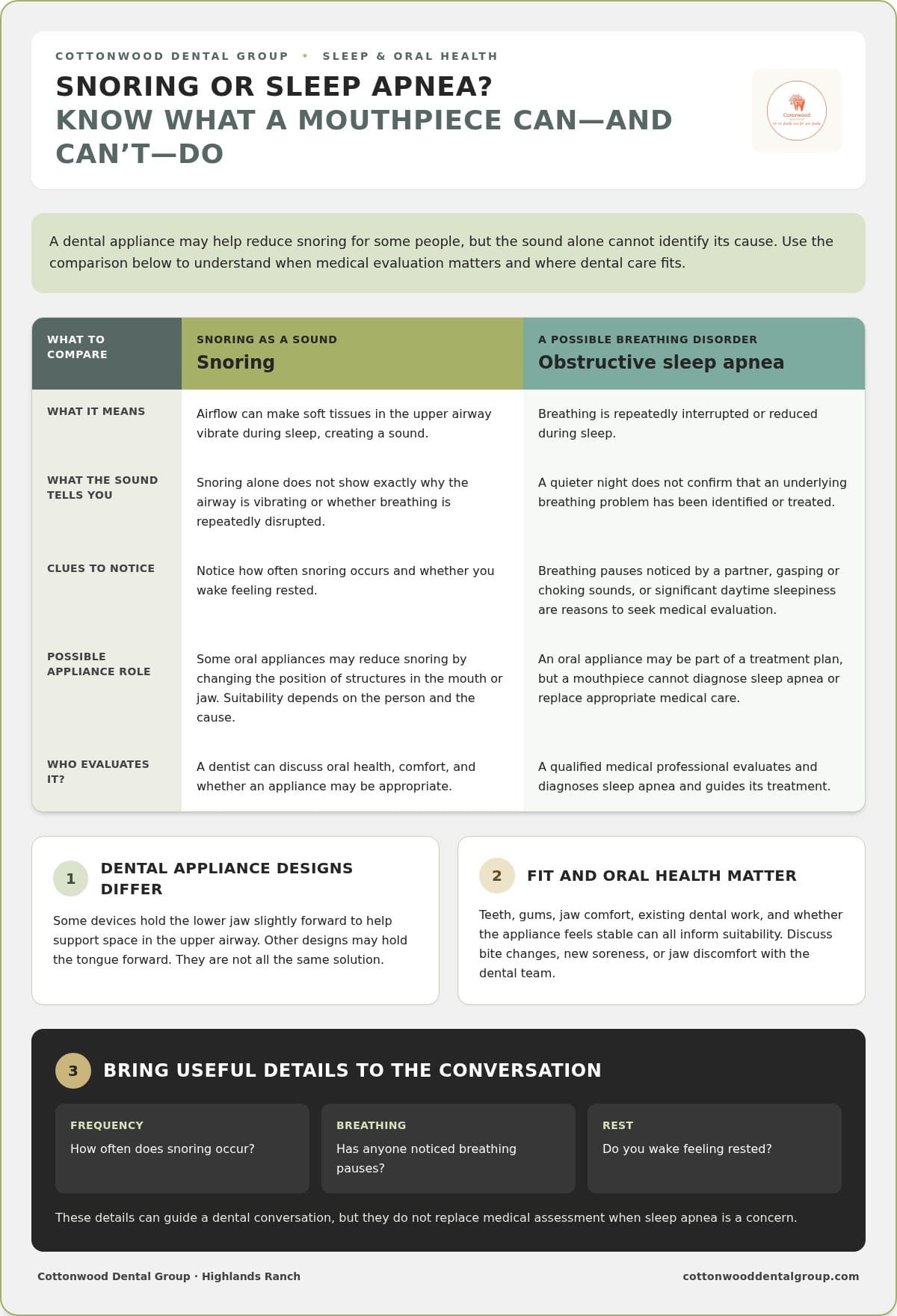
Snoring is a sound that can occur when airflow makes soft tissues in the upper airway vibrate during sleep. The sound alone doesn’t reveal exactly why the airway is vibrating or whether breathing is repeatedly disrupted.
Obstructive sleep apnea involves recurring interruptions or reductions in breathing during sleep. Pauses noticed by a partner, gasping or choking sounds, and significant daytime sleepiness are reasons to seek medical evaluation. A dentist can discuss oral health and appliance considerations, but doesn’t diagnose sleep apnea. A qualified medical professional evaluates the condition and guides its diagnosis and treatment.
When should Parker residents consider a dental consultation?
A dental consultation can help you discuss what you or your partner have noticed, review relevant oral health considerations, and explore whether a dental appliance may be appropriate. Be ready to describe how often snoring occurs, whether anyone has noticed breathing pauses, and whether you wake feeling rested. These details can guide the conversation, but they don’t replace medical assessment when sleep apnea is a concern.
Dental appliances aren’t suitable for everyone. Comfort, oral health, and the suspected cause of snoring all matter. If symptoms point to possible sleep apnea, medical evaluation should guide the next step. When an oral appliance is part of a sleep apnea treatment plan, the dentist provides dental care related to the appliance, while the medical professional remains responsible for diagnosis and overall sleep-disorder management.
Cottonwood Dental Group is located in Highlands Ranch and serves patients from Parker, Lone Tree, Centennial, and Castle Pines. Its personalized sleep apnea treatment gives patients a place to discuss concerns and understand how dental care may fit into a broader plan. The practice’s Sleep Apnea Treatment in Highlands Ranch guide offers more information about local care.
If you’re searching for a stop snoring mouthpiece dentist Parker, start by separating the goal of reducing snoring from the need to identify its cause. Persistent, loud snoring, breathing pauses, gasping, or marked daytime sleepiness deserve medical attention. A dental conversation can then help clarify oral appliance considerations without treating a mouthpiece as a substitute for diagnosis.
How a Dentist-Fitted Stop Snoring Mouthpiece Works
Some oral appliances are designed to hold the lower jaw slightly forward during sleep. This can help support space in the upper airway, where soft tissues may otherwise narrow the passage and vibrate as air moves through. Other designs may hold the tongue forward. The approaches differ, so consider a mouthpiece by its design and intended use rather than treating every device as the same solution.
A mandibular advancement device holds the lower jaw in a forward position during sleep to help support the upper airway, but its effect depends on the individual and the cause of the snoring. This describes a general mechanism, not a promise that snoring will stop or that sleep apnea will be treated.
What is a mandibular advancement device?
A mandibular advancement device, often shortened to MAD, is an oral appliance that positions the mandible, or lower jaw, forward. By changing jaw position, it may help create more room behind the tongue and support airflow during sleep. Design and suitability vary. A dental assessment helps determine whether this type of appliance fits a person’s oral health and needs.
“Dental snoring appliance” is a broad term, not a guarantee of a particular design. A device discussed for snoring alone has a different context from an oral appliance prescribed as part of obstructive sleep apnea care. Sleep apnea must be diagnosed by a qualified medical provider. For apnea treatment, the medical provider directs diagnosis and overall care, while the dentist’s role may include creating and adjusting an appliance prescribed for that purpose.
Why fit and oral health matter
An appliance needs to stay in place and feel manageable during sleep. If it feels uncomfortable or unstable, regular use may be difficult. Teeth, gums, jaw comfort, and existing dental work can all inform whether an oral appliance is suitable and how its fit should be considered. A generic mouthpiece may not be an appropriate match for everyone.
After beginning to use an appliance, pay attention to how your teeth and jaw feel. Discuss a change in your bite, new soreness, or jaw discomfort with the dental team rather than simply pushing through. Follow-up can provide an opportunity to review comfort and fit and address concerns as they arise.
For Parker residents exploring a stop snoring mouthpiece dentist Parker option, a useful first step is a personalized conversation about the goal: addressing snoring, following a medical sleep apnea diagnosis, or both. Cottonwood Dental Group offers sleep apnea treatment through personalized dental care. A discussion with the dental team can help clarify how oral health and appliance considerations fit into the care plan. Learn more about personalized sleep apnea treatment at Cottonwood Dental Group.
Custom Mouthpiece, Store-Bought Guard, or CPAP: What Should You Compare?
These options work differently, so start by identifying the purpose of treatment. An over-the-counter mouthguard may seem like a quick way to address snoring, while a custom dental appliance involves individualized dental assessment. CPAP is a separate approach used in sleep apnea care. No option is right for everyone. Diagnosis, health history, comfort, and guidance from the treating clinicians all matter.
| Option | Assessment and fit | Intended role and follow-up |
|---|---|---|
| Custom dental appliance | Selected and fitted with dental assessment; fit is considered in light of oral health and individual needs. | May be considered for snoring or prescribed as part of sleep apnea care. Dental follow-up can address fit and comfort; apnea treatment also requires medical oversight. |
| Over-the-counter mouthpiece | Purchased without an individualized dental assessment; fit and adjustment depend on the device. | May be used by some people seeking snoring relief. It doesn’t establish why snoring occurs or diagnose sleep apnea. |
| CPAP | Used according to clinical guidance, with a mask and equipment selected for the treatment plan. | Delivers pressurized air to help keep the airway open during sleep. Use and ongoing management follow sleep apnea care guidance. |
Custom dental appliance versus an over-the-counter mouthpiece
A custom dental appliance begins with a closer look at a person’s oral health and needs. An over-the-counter device doesn’t include the same individualized dental assessment before purchase. That doesn’t mean every store-bought device is unsuitable, but its fit and the reason for snoring may not have been evaluated by a dental or medical professional.
If snoring continues, repeatedly switching mouthpieces may delay finding out what’s behind it. A device that changes the sound doesn’t confirm that breathing is normal during sleep. Persistent loud snoring, breathing pauses, or other concerning symptoms call for medical evaluation rather than relying on trial and error alone.
Oral appliance versus CPAP for sleep apnea
CPAP uses a mask connected to equipment that sends pressurized air to help keep the airway open. An oral appliance works through positioning in the mouth and jaw. They’re distinct treatments, not interchangeable products. Oral appliances may be considered for some people with sleep apnea, while CPAP remains the standard treatment approach for severe obstructive sleep apnea. The appropriate plan depends on clinical evaluation and individual circumstances.
For someone with suspected or diagnosed sleep apnea, treatment decisions should follow medical guidance. A stop snoring mouthpiece dentist Parker search can be a starting point for understanding dental options, but a dentist doesn’t diagnose sleep apnea. Cottonwood Dental Group offers personalized sleep apnea care in Highlands Ranch for patients from Parker and nearby communities, including Lone Tree, Centennial, and Castle Pines. A dental conversation can clarify how oral health and appliance considerations may fit into a broader plan. Explore sleep apnea care at Cottonwood Dental Group.
What to Expect From Mouthpiece Evaluation, Fitting, and Follow-Up
A mouthpiece evaluation connects your sleep concerns with your oral health and helps determine whether an appliance may be appropriate. The process can involve several stages, depending on your symptoms, dental needs, and whether sleep apnea is suspected or already diagnosed. Understanding what each stage addresses can make the conversation more focused.
What happens during an initial dental assessment?
The discussion may cover how often you snore, what a partner has observed, whether you wake feeling rested, and any other sleep concerns. Sharing relevant medical history and details about your teeth, gums, jaw, and existing dental work can help the dental team consider oral suitability. This assessment looks at dental factors; it isn’t a diagnosis of sleep apnea.
If symptoms suggest possible sleep apnea, a medical professional can evaluate the concern and determine whether a sleep evaluation, such as a sleep study, is appropriate. For an oral appliance used to treat obstructive sleep apnea, a qualified medical provider diagnoses the condition and prescribes treatment; the dentist provides dental care related to the appliance. Coordination helps keep the dental assessment and medical diagnosis in their proper roles.
From assessment to fitting
If an appliance is considered appropriate, the dental team can explain the next steps for evaluating fit and comfort. Details depend on the treatment plan, so fitting is individualized rather than a single standard process. The aim is to discuss whether the appliance can be worn comfortably and retained during sleep, while taking your oral health into account.
A useful evaluation should answer: What may be causing my snoring, do my symptoms warrant medical sleep evaluation, is my oral health suitable for an appliance, how will comfort and fit be reviewed, and what should I do if symptoms continue?
Adapting to an appliance and monitoring progress
Getting used to an oral appliance can feel different from person to person. Comfort, fit, and the experience of wearing it overnight are worth discussing openly. If you notice jaw discomfort, soreness, a change in how your teeth meet, or difficulty keeping the appliance in place, tell the dental team rather than making adjustments on your own.
Follow-up offers a chance to review fit and discuss your experience, including whether snoring or other symptoms persist. It doesn’t guarantee a particular result, and continued symptoms should be taken seriously. If sleep apnea is part of the concern, medical follow-up remains important; the dental team’s review doesn’t replace assessment of the sleep condition.
For Parker residents considering a stop snoring mouthpiece dentist Parker consultation, Cottonwood Dental Group in nearby Highlands Ranch offers personalized sleep apnea treatment and dental care. You can discuss sleep apnea care with the dental team and learn how oral health considerations may fit into a medically guided plan.
Find Dentist-Guided Snoring Mouthpiece Care Near Parker
Choosing what to do about snoring can feel uncertain, especially if you’re not sure whether it’s simply disturbing sleep or connected to a breathing concern. A personalized dental conversation can help you understand how oral health and appliance considerations relate to sleep apnea care, while keeping diagnosis and treatment decisions in the right clinical context.
How Cottonwood Dental Group supports personalized sleep apnea care
Cottonwood Dental Group is a concierge dental practice in Highlands Ranch serving patients from Parker, Lone Tree, Centennial, and Castle Pines. Its sleep apnea treatment and personalized approach provide a setting to discuss sleep-related concerns, dental health, and questions about oral appliance options. The conversation is guided by your needs rather than an assumption that one mouthpiece is right for everyone.
If sleep apnea is suspected, a qualified medical professional is responsible for evaluating and diagnosing the condition. Dental care can be considered as part of a broader treatment plan when appropriate, with medical guidance informing care for diagnosed sleep apnea. A discussion about a mouthpiece doesn’t take the place of an assessment of breathing during sleep.
For Parker residents, Cottonwood Dental Group’s Highlands Ranch location is a nearby option for discussing the dental aspects of sleep apnea care. A consultation can help clarify what questions to address, what oral health factors may matter, and how dental considerations might fit alongside medical sleep care. The aim is a more informed conversation, not a promise that an appliance will stop snoring for every patient.
Your next step toward a more informed choice
Before a dental consultation, note what you’ve observed and what you’d like to understand. Useful details to bring include:
- How often snoring occurs and whether it disrupts your sleep or a partner’s rest
- Whether someone has noticed breathing pauses, gasping, or other changes during sleep
- Any sleep-related evaluation or diagnosis you’ve already received
- Questions about oral appliance suitability, comfort, and how dental care may relate to your sleep treatment plan
These details can help make the conversation focused and personal. If you’ve already been evaluated for sleep apnea, sharing relevant guidance from your medical professional can help the dental team understand the context for discussing oral appliance options. If you haven’t, concerns such as breathing pauses or significant daytime sleepiness are important to raise as part of seeking appropriate medical evaluation.
If you’re searching for a stop snoring mouthpiece dentist Parker, take the next step with a conversation centered on your symptoms and questions. Contact Cottonwood Dental Group to discuss sleep-related concerns and personalized sleep apnea care near Parker.
Take the Next Step Toward More Restful Nights
Choosing what to do about snoring doesn’t have to begin with buying another device. Start with a clear picture of your concerns and the guidance you need. A thoughtful conversation can help you decide what questions to raise, what information to bring, and how to approach the next step.
If you’re looking for a stop snoring mouthpiece dentist Parker, let your individual needs guide the discussion rather than expecting one solution to work for everyone. Cottonwood Dental Group’s personalized concierge approach gives patients a place to talk through sleep-related concerns and dental care.
Contact Cottonwood Dental Group to discuss personalized sleep apnea care and take a considered first step toward understanding your options.
Frequently Asked Questions
Can a dentist-fitted mouthpiece stop snoring?
A dentist-fitted mouthpiece may reduce snoring for some people, but it can’t guarantee that snoring will stop. Its usefulness depends on the cause of the sound, whether the appliance suits your needs, and whether you can wear it comfortably. If snoring changes alongside nasal congestion or sleep position, for example, a mouthpiece may not address every contributing factor. Ongoing loud snoring deserves attention rather than assuming the appliance has solved the cause.
Can a snoring mouthpiece treat sleep apnea?
An oral appliance may be part of obstructive sleep apnea treatment when a qualified medical professional has diagnosed the condition and prescribed the appliance. It isn’t a substitute for diagnosis, and a dentist doesn’t determine whether you have sleep apnea. The dentist’s role is to provide dental care related to the appliance, while the medical professional guides overall sleep care. If you already have a diagnosis, share your treatment guidance during the dental discussion.
Is a custom snoring mouthpiece better than an over-the-counter device?
Not automatically for every person. A custom appliance is considered in the context of your dental health and individual fit, while an over-the-counter device is purchased without that personalized dental assessment. The distinction can matter if you have crowns, missing teeth, gum concerns, or jaw discomfort. A store-bought device may seem convenient, but if snoring persists, changing devices repeatedly won’t identify whether an underlying sleep concern needs evaluation.
Can a mouthpiece cause jaw pain or change your bite?
Jaw soreness or a change in how your teeth meet can occur with oral appliance use, so let your dental team know if you notice either. Describe when the discomfort began, whether it eases after removing the appliance, and whether chewing feels different. Don’t reshape or adjust the device yourself. The dental team can consider your symptoms and fit and advise what to do next.
How long does it take to get used to a dental snoring appliance?
There isn’t one timeline that applies to everyone. Some people adapt more easily than others, and early experiences can include noticing the appliance or needing time to find a comfortable routine. Follow the instructions provided for your care, and keep track of soreness, difficulty wearing it, or changes in your bite. If adapting feels difficult, raise it with the dental team rather than abandoning the appliance or forcing use through discomfort.
Do I need a sleep study before getting an oral appliance?
If sleep apnea is suspected, medical evaluation is important, and a sleep study may be used to assess breathing during sleep and support diagnosis. For insurance claims involving an oral appliance for obstructive sleep apnea, a physician-ordered sleep study is generally required. Whether testing is appropriate depends on your symptoms and medical assessment. Snoring alone doesn’t establish sleep apnea, so discuss concerning symptoms with a qualified medical professional.
Can I see a dentist for a snoring mouthpiece if I live in Parker, Colorado?
Yes. Cottonwood Dental Group is in Highlands Ranch and serves patients from Parker and nearby communities, including Lone Tree, Centennial, and Castle Pines. The practice offers personalized sleep apnea treatment, where you can discuss sleep-related concerns and dental considerations as part of your care. If you’re searching for a stop snoring mouthpiece dentist Parker, a dental conversation can help you understand questions to consider and how dental care may fit into medically guided sleep care.
