
October 6, 2026

Do you need a sleep study before getting a dental appliance for sleep apnea? In most cases, yes. A sleep study helps a sleep physician diagnose the condition and assess its severity before treatment is planned. If you’re searching for a sleep study for dental appliance Parker, it helps to understand the distinct roles of sleep testing and dental care.
It’s understandable to feel unsure about where one step ends and the next begins, or whether an oral appliance may suit your diagnosis and comfort needs. Sleep testing provides clinical information, while a dental evaluation considers whether an appliance may be appropriate for your teeth, bite, and individual needs. The sleep physician makes the diagnosis; the dentist evaluates dental suitability and discusses treatment options.
This guide explains what sleep testing can involve, how the results relate to oral appliance treatment, and what to expect at a dental evaluation. Cottonwood Dental Group offers sleep apnea treatment from its Highlands Ranch practice and serves patients in Parker. Knowing what each step does can help you prepare for a more focused conversation about care.
Key Takeaways
- A sleep study for dental appliance Parker patients helps establish a diagnosis before treatment options are considered.
- In-lab studies and home sleep apnea tests use different approaches. A clinician determines which testing method fits your circumstances.
- Oral appliances and CPAP work differently. Diagnosis and individual clinical needs help guide the treatment discussion.
- Bring your sleep-study report and relevant treatment history to your dental evaluation, and note symptoms and questions you want to discuss.
- Cottonwood Dental Group’s Highlands Ranch practice serves Parker patients and offers a personalized setting to discuss dental treatment after sleep evaluation.
Sleep Study for a Dental Appliance in Parker: Why Testing Comes First
Should you start with a dentist, a sleep study, or both? It’s a common question when snoring, disrupted sleep, or daytime fatigue leads you to consider an oral appliance. The steps have different purposes: sleep testing helps a clinician assess what may be happening during sleep, while a dental evaluation considers whether an appliance may be suitable for you.
A sleep study records information about breathing and related sleep patterns to help assess sleep-related breathing disorders. For suspected obstructive sleep apnea, a sleep physician uses the test results alongside relevant clinical information to make a diagnosis. A dental consultation can address treatment options, but it does not replace that medical diagnosis.
What does a sleep study tell you about sleep apnea?
Depending on the type of test, overnight monitoring can record breathing patterns and other signals related to sleep. Clinicians use this information to assess whether breathing is repeatedly disrupted. Results need clinical interpretation, and they do not determine a treatment on their own. For a general overview of obstructive sleep apnea, including how sleep studies relate to diagnosis, see this reference.
Sleep testing helps clinicians assess and diagnose sleep-related breathing problems; a dental evaluation helps determine whether an oral appliance may be appropriate. Keeping those roles clear can make the process easier to navigate. Symptoms can prompt a conversation, but they do not establish a diagnosis or show which treatment is right for you.
Why does a dental appliance require an evaluation?
An appliance needs to suit both the diagnosed condition and the individual patient. During a dental evaluation, the dentist considers your oral health and treatment needs when discussing oral appliance options. This assessment connects the sleep-related diagnosis with a practical dental treatment discussion.
Different patients and diagnoses can call for different approaches. An oral appliance may be considered in some circumstances, while another treatment may be more appropriate based on the clinician’s findings and the patient’s needs. Comfort is part of the conversation, so share concerns about dental treatment or previous experiences.
For Parker-area patients, the sequence is straightforward: pursue appropriate sleep evaluation first, then discuss dental treatment options with a dental team. Cottonwood Dental Group provides sleep apnea treatment at its Highlands Ranch practice and serves patients in Parker, Lone Tree, Centennial, Castle Pines, and nearby communities. A sleep study for dental appliance Parker patients is part of understanding the diagnosis, not a guarantee that one specific device will be the right fit.
How Sleep Studies Work Before Oral Appliance Treatment
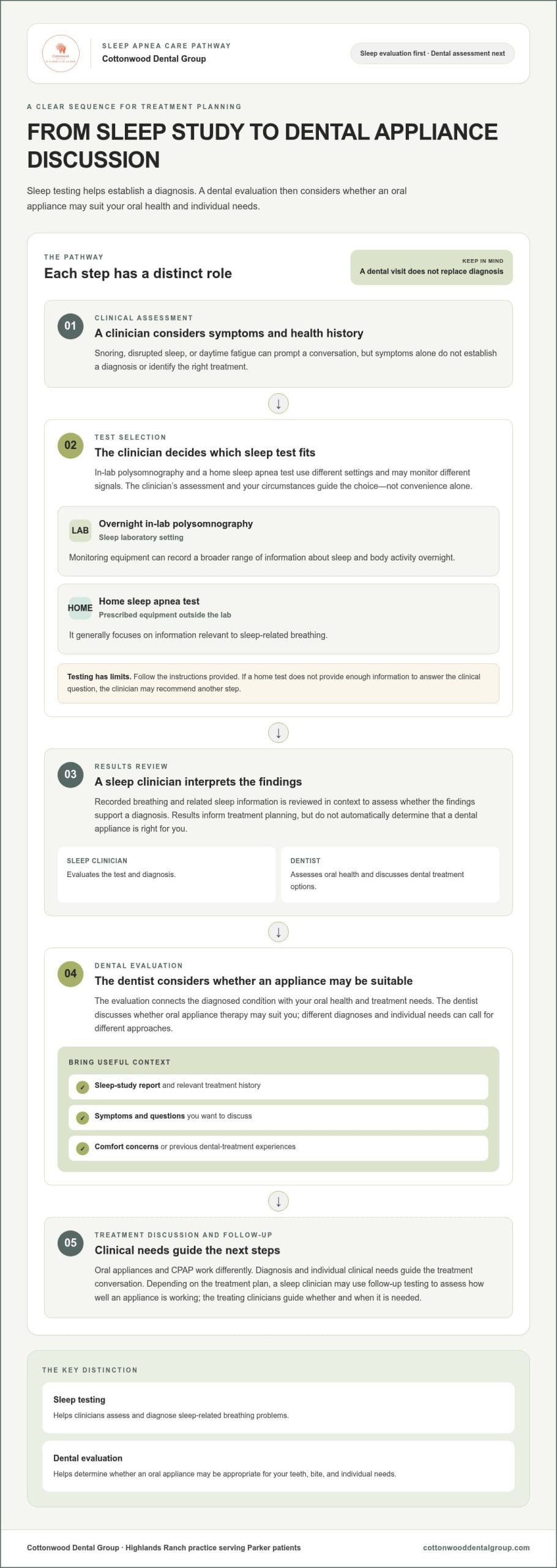
Sleep testing isn’t one-size-fits-all. The clinician assessing your symptoms and health history determines which approach is appropriate. Two common options are an overnight in-lab polysomnography and a home sleep apnea test. Both gather information related to breathing during sleep, but they take place in different settings and may monitor different signals.
In-lab sleep study or home sleep apnea test: what differs?
An in-lab polysomnography takes place in a sleep laboratory, where monitoring equipment can record a broader range of information about sleep and body activity overnight. A home sleep apnea test uses prescribed equipment outside the lab and generally focuses on information relevant to sleep-related breathing. Your circumstances and the clinician’s assessment guide the choice. Don’t select a test type based on convenience alone.
Each test has limits, and a clinician needs to interpret the recorded information in context. If a home test doesn’t provide enough information to answer the clinical question, the clinician may recommend another step. Follow the instructions provided for your test, and raise any concerns about completing it with the clinician overseeing your evaluation.
What happens after the sleep study results are reviewed?
A sleep clinician reviews the findings to determine whether they support a diagnosis and to discuss appropriate treatment options. The results inform that conversation, but they do not automatically establish that a dental appliance is right for you. Treatment decisions depend on the diagnosis and your circumstances.
Medical and dental professionals contribute different expertise. The sleep clinician evaluates the test and diagnosis; a dentist assesses oral health and discusses whether oral appliance therapy may suit the patient. The joint American Academy of Sleep Medicine and American Academy of Dental Sleep Medicine clinical guideline addresses oral appliance care, including follow-up evaluation. Depending on the treatment plan, a sleep clinician may use follow-up testing to assess how well an appliance is working. The treating clinicians guide the need and timing.
If you’re researching a sleep study for dental appliance Parker, follow the clinician’s testing recommendation, then bring the results to a dental evaluation to discuss options. Parker patients can explore personalized sleep apnea treatment at Cottonwood Dental Group’s Highlands Ranch practice. Discuss oral appliance treatment as part of that next step.
Oral Appliance vs. CPAP: How Testing Helps Guide the Choice
A sleep study provides information that helps the sleep clinician diagnose obstructive sleep apnea and understand its characteristics. Those findings, together with your health and treatment preferences, inform a conversation about options. An oral appliance isn’t automatically right for every patient, and CPAP isn’t the only treatment that may be discussed. The goal is to consider an approach suited to your clinical needs.
| Treatment | General approach | What to discuss |
|---|---|---|
| Oral appliance therapy | A dental appliance is worn in the mouth during sleep to help keep the airway open. | Diagnosis, oral health, dental suitability, comfort, and the clinician’s treatment recommendation. |
| CPAP | A device delivers pressurized air through an interface worn during sleep. | Clinical needs, comfort with the equipment, and how the therapy fits your routine. |
When might oral appliance therapy be discussed?
Oral appliance therapy may be an option for some people with obstructive sleep apnea, depending on their diagnosis and circumstances. A dental assessment considers oral health and whether this treatment is suitable for the individual. The American Academy of Dental Sleep Medicine describes oral appliances as a treatment for snoring and obstructive sleep apnea, but that doesn’t mean every patient is a candidate or that an appliance will produce the same result for everyone.
Comfort and practicality matter, but they’re considered alongside the clinical picture. Use a dental visit to discuss concerns about fit or wearing an appliance and to understand how those factors may affect the treatment conversation.
How does CPAP differ from a dental appliance?
CPAP uses a device to deliver air pressure through an interface during sleep. An oral appliance is worn in the mouth and works through a different approach. Neither option is a universal solution or a cure. The appropriate discussion depends on the diagnosis and individual needs.
Share your preferences and concerns with the professionals involved in your care, including any difficulty you anticipate with a device or appliance. If you’re exploring a sleep study for dental appliance Parker, test results can help frame the discussion, while a dental evaluation considers oral appliance suitability. Parker patients can discuss sleep apnea treatment at Cottonwood Dental Group’s Highlands Ranch practice. Explore oral appliance treatment as a possible next step after appropriate sleep evaluation.
Preparing for a Dental Appliance Consultation After a Sleep Study
Once your sleep study has been reviewed, a little preparation can make a dental consultation more useful. Bring information about your diagnosis and treatment history, then use the visit to discuss whether oral appliance therapy fits your dental health and care needs. Cottonwood Dental Group’s practice is in Highlands Ranch and serves patients from Parker and nearby communities.
What information should you bring to the dental visit?
Bring a copy of your sleep-study report and any recommendations from your sleep clinician, if available. These records give the dental team context for discussing treatment. You can also prepare a short list of:
- Symptoms you’ve noticed, such as snoring, disrupted sleep, or daytime tiredness.
- Current or previous sleep apnea therapies, including concerns or challenges.
- Questions about comfort, wearing an appliance, or how treatment may fit your routine.
- Relevant dental history and current concerns, such as tooth or jaw discomfort.
You don’t need to interpret the sleep-study findings yourself. Sharing the report and your experiences helps the dental team understand what you’d like to address and consider your oral health as part of the evaluation.
What should you expect during an oral appliance evaluation?
The conversation can cover your diagnosis, your sleep clinician’s recommendations, dental health, and treatment goals. The dentist assesses whether oral appliance therapy may be appropriate for your individual needs and discusses potential options. An evaluation connects your clinical information with a dental assessment. It does not mean that a particular treatment will automatically be selected.
Ask practical questions, too. How will fit be assessed? What adjustments might be needed? What follow-up should you expect, and how will the dental team coordinate with your sleep clinician if questions arise? The answers can clarify the care plan and bring comfort concerns into the conversation early. If the plan includes follow-up, ask how progress will be reviewed.
To prepare for a sleep study for dental appliance Parker consultation, bring your records, note your questions, and be open about your treatment experience. Parker patients can discuss sleep apnea treatment with Cottonwood Dental Group at its Highlands Ranch practice after appropriate sleep evaluation.
Sleep Apnea Treatment Near Parker: Your Next Step with Cottonwood Dental Group
Sleep testing and dental care are connected, but they answer different questions. A sleep clinician reviews test results to support a diagnosis and guide treatment discussions. A dental evaluation explores whether oral appliance treatment may fit your diagnosis, oral health, and individual needs. Understanding these roles can make your next step clearer.
For a broader look at treatment approaches, including CPAP alternatives, read Sleep Apnea Treatment in Highlands Ranch: The 2026 Guide to CPAP Alternatives. Your care plan should be based on your clinical evaluation and conversations with the professionals involved in your care.
How does Cottonwood Dental Group support personalized sleep apnea care?
Cottonwood Dental Group is a concierge dental practice in Highlands Ranch serving patients in Parker and nearby communities. Its personalized approach gives you space to discuss your sleep evaluation, oral health, treatment goals, and comfort concerns. The dental team can assess whether oral appliance treatment is an option to discuss based on your individual needs.
Bring your sleep-study report and any recommendations from your sleep clinician. These details provide helpful context, but a dental visit does not replace medical diagnosis or interpretation of the study. Instead, it builds on that evaluation to explore dental treatment options with attention to your oral health.
How can Parker-area patients take the next step?
Before an appointment, gather your test results, note any current or previous sleep treatments, and write down questions you’d like to cover. You might ask how dental suitability is assessed, what comfort considerations matter, and how the dental discussion relates to your sleep clinician’s recommendations. A short list can help you make the most of the visit.
If you’re researching a sleep study for dental appliance Parker, remember that testing supports diagnosis while dental assessment helps explore appliance treatment. Cottonwood Dental Group is located in Highlands Ranch and serves Parker-area patients. When you’re ready to discuss your situation and potential options, schedule a personalized sleep apnea treatment discussion.
Take the Next Step Toward Personalized Sleep Apnea Care
Understanding how testing and dental care fit together can make your next step clearer. A sleep study helps a sleep clinician assess and diagnose sleep-related breathing concerns, while a dental evaluation explores whether an oral appliance may suit your diagnosis, oral health, and individual needs. Neither treatment option is right for everyone, so a personalized discussion matters.
If you’re researching a sleep study for dental appliance Parker, gather your sleep-study report, clinician recommendations, and questions about comfort or treatment history. These details can make a dental conversation more focused. Sleep apnea treatment is among Cottonwood Dental Group’s specialized services, with individualized care at its Highlands Ranch practice for patients in Parker, Lone Tree, Centennial, Castle Pines, and nearby communities.
A clear conversation can help you understand the dental next steps after appropriate sleep evaluation. Schedule a personalized sleep apnea treatment discussion with Cottonwood Dental Group.
Frequently Asked Questions
Do I need a sleep study before getting a dental appliance for sleep apnea?
Usually, sleep apnea needs to be diagnosed through appropriate sleep testing before dental appliance treatment is considered. A sleep clinician reviews the results and other relevant information to make a diagnosis and guide treatment discussions. A dental consultation then evaluates whether an oral appliance may suit your diagnosis and oral health. The testing approach and next steps depend on your clinician’s assessment and circumstances.
Can a dentist diagnose sleep apnea with an oral appliance consultation?
No. A dental appliance consultation doesn’t replace a medical evaluation or diagnosis by a sleep clinician. The dentist’s role is to assess oral health and discuss whether dental treatment, such as an oral appliance, may be appropriate after a diagnosis. If you notice symptoms like snoring or disrupted sleep, share them with your healthcare professional so they can advise you about evaluation.
What happens during a sleep study for an oral appliance?
A sleep study records information about breathing and related patterns while you sleep. An in-lab polysomnography takes place in a sleep laboratory, while a home sleep apnea test uses prescribed equipment outside the lab. The test itself doesn’t select an appliance. A sleep clinician interprets the findings and discusses diagnosis and treatment options; a dental assessment separately considers whether an oral appliance may fit your needs.
Can a home sleep apnea test qualify me for a dental appliance?
A home sleep apnea test may provide information a sleep clinician uses to assess and diagnose sleep apnea, but it doesn’t automatically qualify someone for a dental appliance. The clinician determines whether the test is appropriate and interprets its results. If a diagnosis supports discussing an appliance, a dentist still needs to evaluate oral health and individual treatment needs before considering dental treatment.
Is an oral appliance as effective as CPAP for sleep apnea?
There isn’t one answer that applies to every patient. CPAP delivers pressurized air through a device and interface, while an oral appliance is worn in the mouth and uses a different approach. The appropriate treatment depends on the diagnosis and personal clinical circumstances. Discuss expected benefits, comfort, and treatment preferences with the professionals involved in your care rather than assuming one option is best for everyone.
Can I get a dental appliance in Parker after a sleep study?
After appropriate sleep evaluation, Parker-area patients can discuss dental treatment options, including oral appliance suitability, at Cottonwood Dental Group. The practice is located in Highlands Ranch and serves patients in Parker, Lone Tree, Centennial, Castle Pines, and nearby communities. A dental evaluation considers your diagnosis, oral health, and individual needs, so a sleep-study result alone doesn’t guarantee that a particular treatment will be selected.
What should I bring to a dental appliance consultation after a sleep study?
Bring your sleep-study report and any recommendations from your sleep clinician, if available. It’s also helpful to note symptoms, current or previous sleep apnea treatments, and comfort concerns. Share relevant dental history and oral health concerns, such as jaw or tooth discomfort. Preparing these details and questions can help the dental team understand your situation and discuss potential options clearly.
