
September 10, 2026

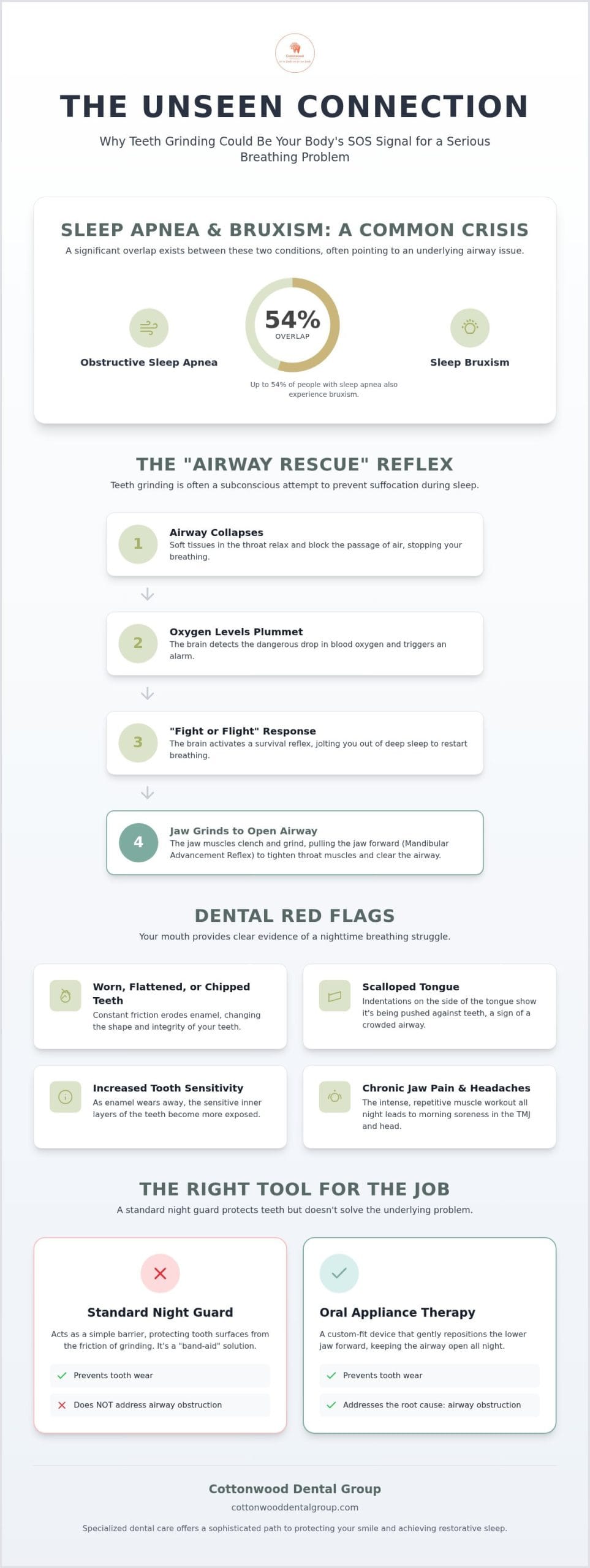
Did you know that your body might be grinding your teeth as a desperate, subconscious attempt to keep you breathing through the night? Recent data suggests that between 33% and 54% of people with obstructive sleep apnea also experience bruxism, showing that the link between sleep apnea and teeth grinding is far more than a simple coincidence. If you find yourself waking up with sensitive teeth, a sore jaw, or a persistent headache, your mouth might be signaling a deeper respiratory issue that impacts your long term health.
It’s incredibly frustrating to wake up feeling drained after eight hours of rest, especially when loud snoring or dental wear adds to your daily stress. We believe you shouldn’t have to manage these symptoms in isolation. This guide will help you understand the biological connection between breathing and bruxism while highlighting how specialized dental care offers a sophisticated path to recovery. You’ll discover how to safeguard your smile from further damage and explore comfortable, modern alternatives to the traditional CPAP machine so you can finally achieve the restorative sleep you deserve.
Key Takeaways
- Discover how sleep apnea and teeth grinding are intimately connected and why bruxism is often your body’s emergency signal for a blocked airway.
- Learn to recognize dental “red flags” such as a scalloped tongue or worn-down enamel that indicate your sleep quality is at risk.
- Understand why a standard night guard might not be enough and how specialized oral appliance therapy addresses the root cause of breathing interruptions.
- Explore the “Airway Rescue” theory to see how subconscious jaw movements work to restart your breathing during the night.
- Find out how a concierge dental approach provides comfortable, effective alternatives to CPAP for a better night’s rest and a protected smile.
Understanding the Connection Between Sleep Apnea and Teeth Grinding (Bruxism)
Many people assume that waking up with a sore jaw is simply the result of a stressful workday. However, your dentist might see a much more complex story written on the surfaces of your teeth. The relationship between sleep apnea and teeth grinding is a critical health indicator that often goes unnoticed until significant dental wear occurs. Because dentists are trained to spot the earliest signs of enamel erosion and jaw tension, they often serve as the first line of defense in identifying systemic issues that affect your breathing and overall longevity. This is especially vital considering that approximately 80% of obstructive sleep apnea cases in the US remain undiagnosed.
What is Obstructive Sleep Apnea?
Obstructive sleep apnea (OSA) occurs when the soft tissues in the back of the throat collapse during sleep, physically blocking the passage of air. When your brain realizes you aren’t receiving enough oxygen, it triggers a “fight or flight” response to wake you up just enough to clear the airway. This constant interruption prevents you from reaching the deep, restorative stages of rest necessary for cognitive function and cardiovascular health. While loud snoring is a well known indicator, many patients also experience:
- Chronic morning headaches caused by oxygen deprivation and poor sleep quality.
- Severe daytime fatigue that makes it difficult to focus at work or home.
- Waking up gasping or choking as the body struggles to restart the breathing process.
The Clinical Link: Sleep Bruxism Explained
Sleep bruxism is the medical term for grinding or clenching your teeth while you sleep. While many still view it as a stress habit, modern research shows it’s often a functional response to a restricted airway. When the airway begins to close, the body may instinctively clench the jaw to create tension in the throat muscles, helping to keep the breathing passage open. According to data from SleepApnea.org in March 2026, between 33% and 54% of individuals with obstructive sleep apnea also grind their teeth. When we evaluate patients for sleep apnea and teeth grinding, we look for clinical signs of this persistent friction, such as:
- Flattened, chipped, or fractured tooth surfaces that require restorative care.
- Increased sensitivity to hot and cold foods as enamel thins over time.
- Chronic pain or clicking in the temporomandibular joints (TMJ) and surrounding muscles.
Ultimately, the co-occurrence of OSA and bruxism serves as a protective reflex where the jaw muscles work overtime to prevent the airway from fully collapsing during the night.
Why Your Body Grinds Teeth to Keep You Breathing
Have you ever considered that your teeth grinding might actually be a life-saving reflex? While it’s common to view bruxism as a byproduct of daily stress, the “Airway Rescue” theory suggests your body uses these movements to prevent suffocation. When your airway collapses during sleep, your blood oxygen levels begin to plummet. This drop sends an immediate emergency signal to the brain, shifting you from a restful state into a “fight or flight” mode. To restart the flow of air, the brain activates the jaw muscles to clench or grind, which helps to reposition the tongue and open the throat.
This cycle of airway collapse and grinding creates a relentless loop that destroys your sleep quality. Each time your breathing is interrupted, your nervous system jolts you just enough to move your jaw, preventing you from ever reaching the deep, restorative stages of rest. This is why many people who suffer from sleep apnea and teeth grinding wake up feeling physically and mentally exhausted. Treating the dental wear with a generic guard without addressing the underlying respiratory blockage is like putting a bandage on a broken bone; it hides the surface damage but leaves the primary health threat untouched. To address the broader impact on your well-being, you can discover HealthWorksPros and their primary health and psychiatric services.
The Mandibular Advancement Reflex
During an apnea event, the brain specifically engages the masseter muscles to pull the lower jaw forward. This is known as the mandibular advancement reflex. While this instinctive movement helps stabilize the airway, it puts immense, repetitive strain on the temporomandibular joints (TMJ) and the surrounding facial muscles. If your jaw feels tight, sore, or clicks when you eat breakfast, it’s likely because your facial muscles have been performing a high-intensity workout all night just to keep your airway open. Over time, this constant tension can lead to chronic pain and permanent changes in your bite.
The Danger of Misdiagnosis
Choosing a standard, over-the-counter night guard can be risky if you have undiagnosed sleep apnea. These devices are designed solely to protect enamel from friction, but they do nothing to support your airway. In some cases, a soft or bulky “boil and bite” night guard can actually crowd the mouth and push the tongue further back into the throat, significantly worsening the severity of your apnea. It’s essential to receive a professional screening before committing to any appliance that could impact your breathing. If you’re concerned about your jaw health and sleep quality, we invite you to explore our concierge approach to sleep apnea treatment to ensure you’re addressing the root cause rather than just the symptoms.
Night Guards vs. Oral Appliance Therapy: Which Is Right for You?
When you’re dealing with the dual burden of sleep apnea and teeth grinding, choosing the right oral device is more than a matter of comfort; it’s a critical health decision. While many patients assume that any plastic tray worn at night will solve their problems, there is a profound functional difference between a standard night guard and a medical-grade oral appliance. Understanding these differences is essential to ensuring you protect your teeth without compromising your ability to breathe deeply and consistently throughout the night.
Standard Night Guards: Protection Only
A standard night guard is primarily designed to act as armor for your enamel. Its purpose is straightforward: to provide a physical barrier that prevents the upper and lower teeth from making contact. This effectively stops the friction that leads to chips, cracks, and flattened chewing surfaces. While these devices are excellent for preserving dental work, they have significant limitations. A standard guard does nothing to improve oxygen levels or stabilize the airway. In fact, for patients with undiagnosed obstructive sleep apnea, a bulky, over-the-counter guard can sometimes crowd the mouth and inadvertently worsen an airway obstruction by allowing the tongue to slip further back into the throat.
Oral Appliance Therapy: The Dual Solution
A Mandibular Advancement Device (MAD) is a sophisticated piece of medical technology that addresses both tooth wear and respiratory health. Unlike a passive guard, an oral appliance is engineered to gently shift the lower jaw into a forward position. This subtle adjustment creates tension in the soft tissues of the throat, preventing the airway from collapsing. It is a highly effective, comfortable alternative for those seeking sleep apnea treatment Highlands Ranch, particularly for mild-to-moderate cases or for patients who struggle with the noise and restriction of a CPAP machine.
Choosing a custom-fitted device over a “boil and bite” drugstore option is vital for long-term success. Mass-produced guards are often made of soft materials that can actually stimulate the chewing reflex, potentially increasing the intensity of your grinding. Our concierge approach ensures that your appliance is meticulously calibrated to your unique anatomy. This precision not only protects your smile from sleep apnea and teeth grinding but also ensures the device is comfortable enough to wear every single night. By focusing on a precise fit, we help you achieve the quiet confidence that comes with knowing your health and your sleep are fully protected.
Recognizing the Signs: Is Your Jaw Pain a Symptom of Sleep Apnea?
Identifying the connection between your oral health and your sleep quality often begins with a few subtle clues you notice each morning. Do you wake up with a persistent dry mouth or a scratchy, sore throat? These symptoms frequently indicate that you’ve been breathing through your mouth all night, a common compensation for a blocked nasal passage or a collapsing airway. When combined with “brain fog” or a morning headache, these signs suggest that your body struggled to maintain oxygen levels while you were unconscious. While you might focus on the jaw pain itself, these systemic indicators are pieces of a larger puzzle involving sleep apnea and teeth grinding.
Your sleep partner often provides the most startling evidence. While they may mention your snoring, they might also report the sound of “loud grinding” that resembles stones rubbing together. More concerning are the moments of silence followed by a sudden gasp or choking sound. This is the sound of your body’s survival mechanism kicking in to restart your breathing. If you are experiencing these episodes, it’s a clear signal that your grinding isn’t just a habit; it’s a response to a respiratory emergency.
Visual Cues in the Mouth
During a professional consultation, we look for specific “red flags” that go beyond simple cavities. One of the most telling signs is a scalloped tongue, where the edges of the tongue have indentations from being pressed firmly against the teeth. This occurs when the tongue is forced forward and outward to clear the airway during an apnea event. We also look for bony growths called tori on the roof of the mouth or along the lower jaw, which often develop as the body’s way of reinforcing the jaw against the extreme pressure of nocturnal clenching. Additionally, you might notice abfractions, which are small, V-shaped notches near the gum line, or even receding gums that have been pushed back by the sheer mechanical force of your jaw muscles.
The Impact of Colorado’s Altitude
Living in the beautiful landscapes of Highlands Ranch or Castle Pines brings a unique challenge to sleep health. At an elevation of nearly 6,000 feet, the air is significantly thinner than at sea level. This lower oxygen concentration can exacerbate existing breathing issues, making the effects of sleep apnea and teeth grinding more pronounced. Residents of Lone Tree, Centennial, and surrounding areas may find that their bodies have a smaller “buffer” when the airway is partially blocked, leading to more frequent disruptions in sleep. Because our local climate is so dry, the morning symptoms of thirst and throat irritation are also heightened. If you’ve noticed these red flags, we encourage you to schedule a comprehensive sleep screening at Cottonwood Dental Group to protect your smile and your long-term wellness.
Specialized Sleep Apnea Solutions in Highlands Ranch
At Cottonwood Dental Group, we understand that resolving the complex relationship between sleep apnea and teeth grinding requires more than a one-size-fits-all approach. Our concierge model is designed to provide high-end, personalized care that addresses the unique physiological needs of every patient. Led by Dr. Parsons, our practice focuses on the profound connection between your oral health and your systemic well-being. By treating the root cause of your nighttime breathing struggles, we help you transition from a state of constant survival to one of deep, restorative rest.
We take pride in serving as a trusted guide for patients throughout Highlands Ranch, Parker, and Centennial. Our philosophy centers on clinical excellence and quiet confidence, ensuring that your journey toward better sleep is as comfortable as it is effective. We don’t just look at your teeth; we evaluate how your airway, jaw alignment, and sleep patterns interact to affect your heart health and daily energy levels. This comprehensive perspective is why so many local residents choose our office for specialized care that goes beyond traditional dentistry.
A Personalized Path to Better Sleep
Your journey begins with a specialized sleep consultation where we take the time to listen to your history of snoring, jaw tension, and daytime fatigue. We utilize advanced digital impressions to capture a precise map of your mouth, eliminating the need for messy, uncomfortable putty. These high-resolution scans allow us to create a custom-fitted oral appliance that feels natural and secure. For patients who experience high levels of anxiety regarding dental procedures, we offer sedation dentistry Highlands Ranch to ensure your diagnostic and fitting appointments are entirely stress-free and relaxing.
Treating More Than Just Teeth
The long-term benefits of addressing sleep apnea and teeth grinding extend far beyond protecting your enamel. By stabilizing your airway, you reduce the chronic strain on your cardiovascular system, lowering the risk of hypertension and other heart-related issues. Many of our patients report a significant surge in cognitive clarity and physical stamina once their bodies are no longer fighting for air every night. If you’ve struggled with the bulk and noise of a CPAP machine, our custom oral appliances offer a premium, travel-friendly alternative that fits seamlessly into your lifestyle. Your health is too important to leave to chance. Schedule your sleep apnea evaluation at Cottonwood Dental Group today and take the first step toward a protected smile and a healthier life.
Reclaim Your Rest and Protect Your Smile
Recognizing the link between sleep apnea and teeth grinding is the first step toward reclaiming your energy and health. Those nighttime clenching sounds are often your body’s urgent signal that it’s struggling to breathe. While a generic guard shields your enamel, it doesn’t address the respiratory blockage that leaves you feeling drained each morning. Specialized oral appliance therapy offers a sophisticated, dual solution that protects your teeth while keeping your airway clear and stable.
At Cottonwood Dental Group, Dr. Parsons provides a premium concierge experience designed for your total comfort. Our independent practice focuses on high-end CPAP alternatives that fit seamlessly into your life. By choosing a custom-calibrated device, you’re investing in a future of quiet nights and vibrant mornings. You don’t have to navigate sleep health alone; our expert team is here to guide you toward a more restorative lifestyle.
Take the First Step Toward Better Sleep: Book Your Consultation
We’re committed to helping you achieve a healthy smile that lasts a lifetime. Let’s work together to ensure you wake up feeling truly refreshed every single day.
Frequently Asked Questions
Can sleep apnea cause teeth grinding, or is it the other way around?
Sleep apnea typically acts as the primary trigger for teeth grinding rather than the other way around. When your airway collapses during sleep, your brain sends an emergency signal to your jaw muscles to clench and move forward to reopen the breathing passage. This survival reflex creates the friction known as bruxism. While stress can play a role, the physiological link between sleep apnea and teeth grinding is a primary reason many patients experience chronic dental wear.
How do I know if my grinding is caused by sleep apnea or just stress?
Distinguishing between stress-related bruxism and a sleep disorder involves looking for systemic symptoms. If your grinding is accompanied by loud snoring, waking up gasping, or feeling exhausted after a full night’s rest, it’s likely linked to your breathing. Stress-induced grinding often occurs during the day or leaves you with tension headaches in the evening. A professional evaluation in our Highlands Ranch office can help pinpoint the exact cause through a comprehensive oral examination.
Is an oral appliance as effective as a CPAP machine for sleep apnea?
For patients with mild to moderate obstructive sleep apnea, a custom oral appliance is a highly effective and comfortable alternative to a CPAP machine. While CPAP remains a common standard for severe cases, many patients in Lone Tree and Centennial prefer oral appliances because they are quiet, portable, and easier to wear consistently. Higher patient compliance often leads to better long-term health outcomes compared to a CPAP machine that sits unused in a drawer.
Will my dental insurance cover an oral appliance for sleep apnea?
Most insurance providers categorize oral appliances for sleep apnea as “durable medical equipment” rather than a standard dental benefit. This means the treatment is often covered under your medical insurance policy rather than your dental plan. Our team at Cottonwood Dental Group assists patients from Castle Pines and Parker in navigating their benefits to ensure they understand their coverage. We recommend contacting your provider to verify the specific details of your medical policy.
Can a standard night guard from the store help with sleep apnea?
A standard store-bought night guard is designed only to protect enamel and cannot treat a breathing disorder. In many cases, these bulky devices can actually worsen your condition by taking up valuable space in your mouth and pushing your tongue further back into your throat. This increases the frequency of airway collapses. If you suspect your grinding is a symptom of a deeper issue, a medical-grade appliance is necessary to ensure your safety and health.
What happens if I leave my sleep apnea and teeth grinding untreated?
What happens if I leave my sleep apnea and teeth grinding untreated?
Leaving these conditions untreated can lead to serious systemic health complications beyond just dental damage. Chronic oxygen deprivation increases your risk for hypertension, heart disease, and stroke. Additionally, the constant pressure from grinding can lead to permanent jaw joint disorders and the need for extensive restorative dental work. Addressing the connection between sleep apnea and teeth grinding is essential for protecting both your smile and your long-term cardiovascular wellness. For those seeking to manage these systemic concerns, Unic Advanced Health Services provides primary care and telehealth options to monitor health markers affected by sleep disorders.
Most patients adjust to their custom oral appliance within a few days to two weeks. Because we use digital impressions to ensure a precise, high-end fit, the device feels much more natural than a generic alternative. You might experience some minor jaw tightness or increased salivation during the first few nights as your muscles adapt. Our concierge approach includes follow-up appointments to calibrate the device, ensuring maximum comfort and effectiveness for your specific anatomy.
Why should I see a dentist in Highlands Ranch for a sleep disorder instead of a GP?
While a GP can diagnose a sleep disorder, a specialized dentist like Dr. Parsons possesses the specific expertise in oral anatomy required to provide custom appliance therapy. We focus on the “whole-health” connection, evaluating how your jaw, tongue, and throat tissues interact during sleep. Our Highlands Ranch practice offers a boutique, patient-centric experience where we manage the entire process from the initial screening to the delivery of your custom, medical-grade sleep solution.
