
October 12, 2026

Choosing among sedation options for dental work is less about finding the “strongest” approach and more about understanding what may help you feel comfortable during treatment. If you’re worried about pain, anxiety, or feeling out of control, it’s natural to want clear answers before an appointment.
It also helps to distinguish numbing from sedation. Local anesthetic reduces sensation in a specific area, while sedation is intended to support relaxation or affect awareness. Your comfort plan depends on the treatment, your health history, your concerns, and how you’d like to feel during the appointment.
This guide explains common approaches in plain language and covers practical points to discuss, including safety, preparation, and recovery. Cottonwood Dental Group offers sedation dentistry as part of personalized care in Highlands Ranch. Understanding the general categories can help you describe your concerns and take part in a focused conversation with your dental team.
Key Takeaways
- Understand how sedation differs from local anesthetic so you can describe the comfort support you’re looking for.
- Learn about inhaled, oral, and IV sedation as general clinical categories, not interchangeable choices.
- Consider how treatment needs, appointment demands, health history, and comfort goals may shape a sedation plan.
- Prepare for a conversation with your dental team by organizing your medical history, medications, allergies, and past sedation experiences.
- Explore how Cottonwood Dental Group’s personalized sedation dentistry can support a comfort conversation in Highlands Ranch.
What Does Sedation for Dental Work Do, and How Is It Different from Numbing?
Feeling anxious, sensitive to sounds or sensations, or unsure what to expect before dental treatment is nothing to be embarrassed about. You might be concerned about discomfort, or simply want to feel calmer during an appointment. Understanding what sedation does, and what it doesn’t do, can help you explain your concerns and participate in planning your care.
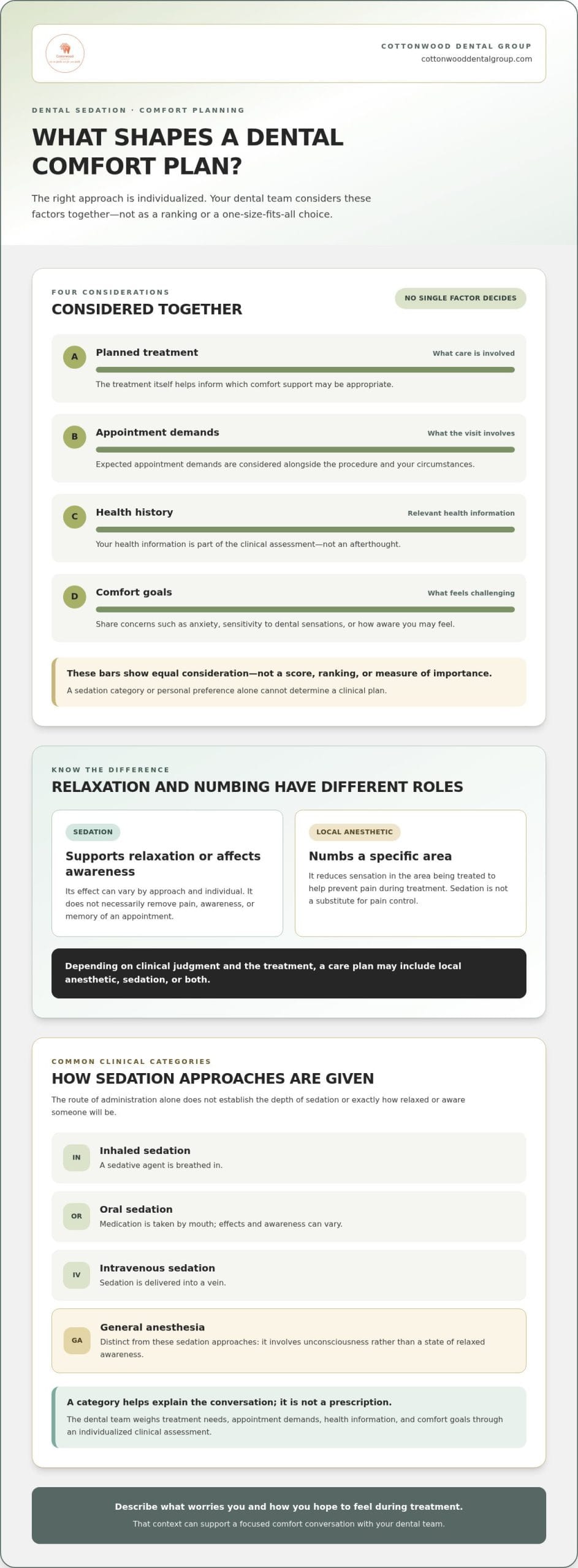
Sedation supports relaxation or changes awareness during care; local anesthesia numbs a specific area to help prevent pain during treatment. These have different roles, and sedation isn’t a substitute for pain control. Depending on clinical judgment and the treatment, a care plan may include local anesthetic, sedation, or both.
Sedation and local anesthesia: two different roles
Local anesthetic reduces sensation in the area being treated. Sedation, by contrast, is intended to help with relaxation or awareness. For example, a person having a tooth treated may receive local anesthesia to numb the treatment area, while a separate comfort plan addresses anxiety. The precise plan depends on the person and the procedure.
Neither approach is a promise that you’ll feel nothing. Sedation doesn’t necessarily remove pain, awareness, or memory of an appointment. If you’re worried about a particular sensation or about staying aware during care, tell your dental team so that concern can be included in the conversation.
What patients may mean by dental sedation
People use “dental sedation” to describe support for feeling less distressed or more comfortable during treatment. The term covers a range of experiences, from feeling relaxed and aware to experiencing deeper sedation. The effect can vary with the approach and the individual, so the term alone doesn’t tell you exactly what you’ll feel.
In broad terms, sedation describes a medically supported state of calm or reduced awareness. Understanding Sedation offers a general overview of the concept and its uses. A dental care conversation can focus on what sedation means for your treatment. For an overview of Cottonwood Dental Group’s approach, explore the Highlands Ranch sedation dentistry guide.
When comparing sedation options for dental work, separate the goal of comfort support from the goal of numbing the treatment area. Describe what worries you, such as feeling tense, being sensitive to dental sensations, or wanting to understand how aware you may be. These preferences help guide a focused discussion, but they don’t determine a clinical plan on their own. Your dental team considers them alongside your treatment and health history.
At Cottonwood Dental Group, sedation dentistry is part of personalized care in Highlands Ranch. Sharing your concerns helps the team understand what feels challenging and consider comfort as part of your overall treatment plan.
What Sedation Options for Dental Work May Involve
Dental sedation isn’t a single technique. It includes several broad clinical approaches that differ in how they’re administered and how they may affect awareness. Inhaled, oral, and intravenous (IV) sedation are common categories. General anesthesia is distinct and involves a deeper level of unconsciousness. These terms can help you follow a conversation, but they aren’t a menu for choosing an approach without a clinical assessment.
The route used to administer sedation doesn’t, by itself, establish its depth. The intended effect and level of care depend on clinical judgment and the patient’s circumstances. A useful comparison considers more than whether an approach is breathed in, swallowed, or delivered through a vein.
How common sedation approaches differ
Inhaled sedation is administered by breathing in a sedative agent. Oral sedation involves medication taken by mouth, and its effects and level of awareness can vary. IV sedation is delivered into a vein. In all three categories, the method of administration alone doesn’t tell you exactly how relaxed or aware someone will be.
General anesthesia differs from these approaches because it involves unconsciousness rather than a state of relaxed awareness. It represents a different depth of care, not simply another way to administer a sedative. An overview from Nationwide Children’s Hospital, Oral Sedation for Dental Work, discusses oral sedation in a dental context, particularly for children. Individual clinical guidance is essential because needs and care plans vary.
Why a list of options is not a prescription
A category can help you understand the discussion, but it can’t identify the right approach on its own. The dentist considers the planned treatment, expected appointment demands, relevant health information, and your comfort goals together. The same method may not suit two patients equally, even when their procedures appear similar.
For example, one person may mainly want support with anxiety, while another may have health considerations that affect the clinical assessment. The dental team weighs these factors rather than relying on a symptom checklist or choosing an approach based on preference alone. Sedation options for dental work are best discussed as part of an individualized care plan, not as a one-size-fits-all choice.
Before the conversation, consider what you hope to feel during treatment and what specifically concerns you. You don’t need to know the name of a sedation method in advance. Describing your comfort goals gives the dental team useful context. Cottonwood Dental Group provides sedation dentistry care in Highlands Ranch as part of its concierge approach to individualized dental care.
How the Procedure and Your Health Shape the Comfort Plan
A thoughtful comfort plan considers both the treatment and the person receiving it. The procedure’s complexity and expected appointment demands matter, as do your health history, previous experiences, and what would help you feel more at ease. No single factor determines the plan on its own.
Sedation also doesn’t automatically mean being fully asleep. Levels of awareness vary, and decisions are based on clinical evaluation rather than an assumption that a particular procedure requires a particular level of sedation. The framework below shows what may come up in that conversation.
| Factor | What the dental team considers | How it informs the discussion |
|---|---|---|
| Procedure complexity | The nature of the treatment, its steps, and the area being treated | More involved care may call for deliberate comfort planning, but it doesn’t automatically point to one sedation approach. |
| Appointment demands | How long the visit is expected to take and whether care may involve repeated appointments | The anticipated demands help the team consider what support may make treatment more manageable. |
| Health history | Medical conditions, current medications, known sensitivities, and previous sedation experiences | This information helps the clinician assess individual considerations and plan safely. |
| Comfort goals | Anxiety triggers, concerns about awareness, and preferences for communication during care | Clear preferences help shape a patient-centered conversation about comfort. |
Which treatment factors can influence the discussion?
A routine visit and a procedure with several stages can place different demands on a patient, but neither description alone determines whether sedation is appropriate. Repeated appointments, treatment complexity, or specific worries about the experience may be reasons to discuss comfort in advance. For implant-specific treatment information, the dental implant guide provides context about that care.
Which personal factors should be part of the assessment?
Share your medical history, medications, allergies or other known sensitivities, and any previous experiences with sedation. Include what made past appointments easier or more difficult. These details are more useful than trying to select an approach based on a checklist or someone else’s experience.
Be candid about what triggers anxiety, such as sounds, sensations, or not knowing what happens next. You can also explain how you prefer to communicate during care. Discuss health conditions too, including sleep-related concerns. The dental team considers this information alongside the planned treatment and your comfort goals. At Cottonwood Dental Group, this individualized conversation is part of personalized care in Highlands Ranch.
How to Prepare for Dental Work with Sedation
A clear plan can make an appointment involving sedation feel more manageable. Preparation is a shared process: your dental team assesses your needs, you provide complete information, and you follow the instructions tailored to your care. Sedation options for dental work and treatment plans vary, so general online advice may not apply to your appointment.
Your dental team’s individualized instructions take precedence over general online advice. Follow the directions provided for your specific treatment, including any guidance about eating, drinking, medications, transportation, and recovery. Don’t rely on general fasting rules or change how you take medication based on advice that wasn’t given for your appointment.
Before the appointment: share information and follow instructions
Preparation begins with an assessment and an up-to-date picture of your health. Share relevant medical history, current medications and supplements, allergies or other known sensitivities, and previous experiences with sedation. Mention any changes to your health or medication list after the assessment. Information that seems unrelated to dentistry can still help your team understand your circumstances.
Use the instructions from your dental team as your practical checklist:
- Review the directions you received for eating, drinking, and taking regular medications.
- Clarify any instruction you don’t understand before the appointment instead of guessing or substituting general advice.
- Make the transportation or appointment arrangements specified by your treating team.
- Keep the practice’s instructions accessible so you can refer to them as the appointment approaches.
Preparation requirements depend on the planned care and sedation approach. There isn’t one set of directions that fits everyone, so don’t assume instructions from a previous visit or another person’s experience apply to you.
After treatment: plan recovery and support
Before treatment, make sure you understand the recovery guidance for your appointment. Depending on your care, it may include directions about activities, support, or follow-up. Transportation or supervision isn’t the same in every situation, so arrange it when your treating team specifies it. If you’re unsure what to expect afterward, ask for the instructions to be explained clearly.
Once you’re home, follow the guidance you were given and pay attention to how you’re feeling. If you have a recovery concern or something doesn’t seem consistent with the instructions, contact the practice for direction. Another person’s recovery experience isn’t a substitute for your own care plan.
Cottonwood Dental Group offers sedation dentistry as part of personalized, concierge care in Highlands Ranch. If you’re preparing for treatment and want to discuss your comfort needs, connect with Cottonwood Dental Group.
Personalized Sedation Dentistry in Highlands Ranch: Your Next Step
A useful comfort conversation considers the whole picture: the treatment being planned, your health history, and what would help you feel more at ease. There isn’t one answer for every patient. These details help your dental team understand your priorities and discuss an approach that reflects your care needs.
You don’t need to arrive with a preferred method in mind. Start with what concerns you. Perhaps certain sounds make you uneasy, you’re worried about remaining aware, or you’ve had a difficult dental experience in the past. Sharing those details gives the team meaningful context.
What to bring to a conversation about dental comfort
A few notes can help you feel prepared and make it easier to cover what matters during your visit. Consider writing down:
- The treatment or parts of the appointment that concern you
- Situations or sensations that tend to trigger anxiety
- Relevant health conditions, current medications, and known sensitivities
- Previous dental or sedation experiences, including what helped or felt difficult
- How you prefer to receive explanations or communicate during care
You don’t need to minimize a concern or describe it in clinical terms. Saying, “I get tense when I can’t see what’s happening,” or “I’d like to know what to expect at each step,” helps the team understand your perspective. Your preferences are one part of the assessment, considered alongside your health information and treatment needs.
Learning about sedation options for dental work can help you take part in the discussion, but online descriptions can’t determine what is appropriate for your circumstances. A personalized conversation lets the dental team address your questions in the context of your planned care.
A local, individualized path forward
Cottonwood Dental Group offers sedation dentistry as part of its personalized, concierge approach to dental care in Highlands Ranch, Colorado. A comfort conversation helps the team understand what matters to you while considering the clinical details of your treatment. Your questions and preferences can be discussed as part of an individualized plan, rather than treated as an afterthought.
For patients in Highlands Ranch and nearby Lone Tree, Centennial, Castle Pines, and Parker, a thoughtful first step is to share what has made dental visits challenging and what would help you feel more prepared. You can discuss the procedure, relevant health details, and your comfort goals with the team.
If you’re considering a more supported dental experience, discuss a more comfortable dental visit with Cottonwood Dental Group. Your concerns are a valuable place to begin.
Take the First Step Toward a More Comfortable Visit
You don’t have to decide on a sedation approach before speaking with your dental team. Start by putting your main concern into words, whether you hope to feel calmer, understand what to expect, or have a past experience considered. That can make the conversation more personal and focused.
As you think about sedation options for dental work, remember that your questions matter alongside the procedure details. It’s reasonable to want clarity before treatment. You can take the conversation one step at a time and explain what would help you feel more comfortable.
Cottonwood Dental Group offers personalized concierge dental care, including sedation dentistry, in Highlands Ranch and nearby communities such as Lone Tree, Centennial, Castle Pines, and Parker. If you’re ready to discuss your comfort concerns and possible next steps, start a conversation about your dental comfort.
A thoughtful plan begins with being heard. You deserve to feel supported as you move toward care.
Frequently Asked Questions
Does dental sedation mean I will be unconscious?
No. Dental sedation doesn’t always mean you’ll be unconscious. Depending on the clinical approach, a person may remain awake and responsive or experience a deeper level of sedation. General anesthesia is different and involves unconsciousness. If staying aware or not remembering parts of treatment concerns you, describe that preference to your dental team. They can explain the intended level of awareness for your proposed care.
Can dental sedation be used for a routine cleaning?
It may be discussed for a cleaning if anxiety, sensitivity, or another individual concern makes routine care difficult, but it isn’t automatically needed or appropriate. The dental team considers what the cleaning involves, your health information, and your comfort goals before making a recommendation. If cleanings have felt challenging in the past, describe which part is hardest, such as sounds, sensations, or sitting through the appointment.
Is local anesthesia the same as dental sedation?
No. Local anesthesia reduces sensation in a particular area, while sedation is intended to support relaxation or affect awareness. A cleaning may not involve the same numbing needs as treatment on a specific tooth, for example. Your dental team can explain what role each approach would serve in your care. Sedation isn’t a replacement for local pain control when numbing is clinically appropriate.
Can my medications or health conditions affect dental sedation?
Yes. Health conditions, prescription medicines, over-the-counter products, and supplements may all be relevant when assessing sedation options for dental work. Give your dentist a complete, current list, including what you take and how often. Don’t stop, skip, or change a medication on your own before an appointment. The dental team can advise you based on your health information and planned treatment.
What should I expect after dental work with sedation?
Recovery can differ depending on the care provided and the sedation plan, so follow the instructions for your appointment rather than assuming you’ll feel a certain way. Before treatment, make sure you understand any guidance about activities, transportation, supervision, and follow-up. If the instructions are unclear or you have a concern after returning home, contact the practice for advice specific to your care.
Should I tell my dentist if I have sleep apnea before sedation?
Yes. Tell your dentist about sleep apnea and any related care or health concerns before sedation is considered. This information helps the team assess your circumstances and plan appropriately. Share relevant medications and details about your condition, and mention any changes since your last visit. Cottonwood Dental Group serves patients in Highlands Ranch, Lone Tree, Centennial, Castle Pines, and Parker, and can include sleep-related concerns in a personalized care discussion.
