
October 14, 2026

Could the right way to clean implant supported dentures depend on whether you take them out? It does. If you’re unsure whether to remove your denture, how to reach beneath it, or which brush and cleanser are safe, you’re not alone. The daily routine is different for removable and fixed dentures, but both need gentle, thorough cleaning to help protect your gums and implant-supported restoration.
This guide walks you through how to clean implant supported dentures with a routine you can follow each day. You’ll learn how to brush and care for a removable denture outside your mouth, or clean around and beneath a fixed denture while it’s in place. We’ll also explain the roles of soft-bristled brushes, interdental brushes, floss threaders, and water flossers, and why abrasive products and hot water may damage some denture materials.
As you build a consistent routine, notice changes in comfort, fit, or gum health. The steps ahead can help you care for your denture at home and recognize when personalized dental guidance is useful.
Key Takeaways
- Identify whether your denture is removable or fixed before choosing a daily cleaning routine.
- Clean gently and thoroughly, paying attention to different areas depending on the denture design.
- Use soft brushes, interdental brushes, flossing tools, water flossers, and denture cleansers for their intended purposes.
- Keep fixed dentures in place at home and clean their visible surfaces and accessible areas underneath.
- Persistent soreness, bleeding, looseness, or new difficulty cleaning are reasons to seek dental guidance.
How to Clean Implant-Supported Dentures Starts With Knowing Your Denture Type
Before choosing a brush or cleanser, find out how your denture is designed to stay in place. An implant-supported denture is retained by dental implants rather than held only by ordinary denture adhesive. Some designs attach to implants but are made to come out for daily cleaning. Others are fixed and remain in place during your home care routine. The distinction matters because it changes which surfaces you can reach and whether you should remove the restoration.
If you’re learning how to clean implant supported dentures, start by identifying your restoration type, then follow its daily routine. General information about Dentures can introduce the different forms dentures may take, but your own dental instructions should guide care for your specific prosthesis.
How can you tell whether your implant denture is removable or fixed?
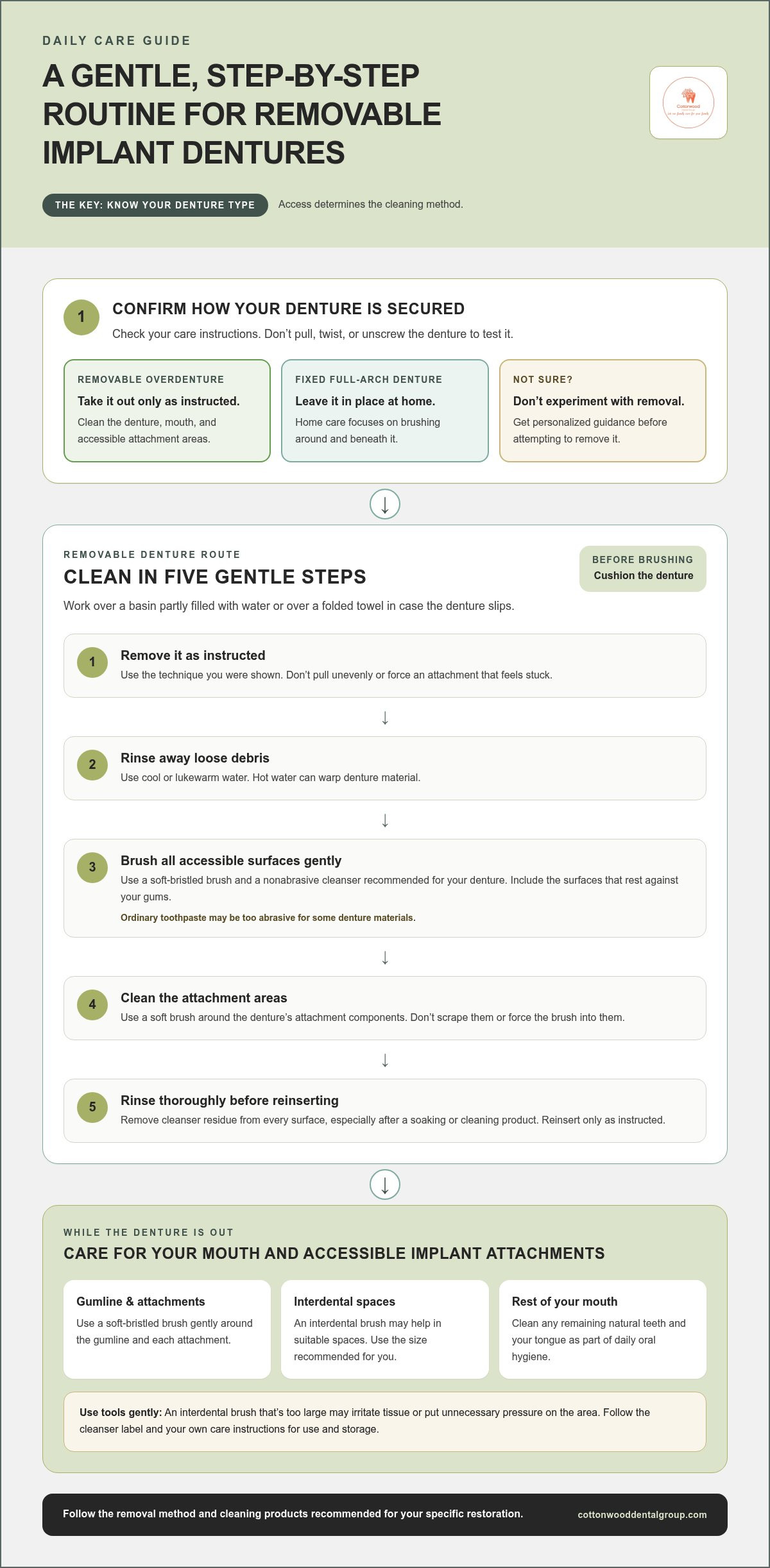
Removable overdentures are designed to be taken out by the patient for routine cleaning. Fixed full-arch prostheses stay in place at home and are removed by a dental professional. Check the instructions you received to confirm how your denture is secured and how to remove it if it is designed to come out.
Don’t pull, twist, or try to unscrew the denture to test it. A restoration that feels snug may still be designed for removal, while forceful handling can risk damage or irritation.
Why the denture type changes the cleaning routine
With a removable design, taking it out gives you access to its underside and attachment areas, as well as the tissues and implant components in your mouth. A fixed design stays in place, so your routine must reach around and beneath the prosthesis without loosening it. The cleaning goal is thorough access, but the method depends on the restoration.
Think of the difference as a change in access, not a difference in the need for care. You can clean a removable denture outside your mouth, while a fixed one requires careful cleaning in place. Even dentures that look similar may have different attachment systems or care directions, so don’t assume another person’s routine will suit yours.
Follow the removal method and cleaning products recommended for your restoration, especially if you’ve recently received it or your instructions specify particular tools. If the denture doesn’t come out as expected, stop rather than applying more force.
- Removable overdenture: Take it out only as instructed, then clean the denture and accessible attachment areas.
- Fixed full-arch denture: Leave it in place at home and focus on brushing and cleaning beneath it.
- Unsure of the design: Avoid experimenting; get personalized guidance before attempting removal.
Once you know which category applies, the next steps become clearer. The following routines explain how to clean removable and fixed implant-supported dentures with appropriate access and care.
How to Clean a Removable Implant-Supported Denture Each Day
A steady routine helps you clean both the denture and your mouth without overlooking implant attachment areas. Follow the removal method you were shown, and refer to your care instructions if your restoration is new or has specific requirements. The steps below offer a general framework for a removable overdenture.
A gentle cleaning sequence for a removable overdenture
Clean the denture over a basin partly filled with water or over a folded towel. This cushions it if it slips from your hands. Use a soft-bristled brush and a nonabrasive cleanser recommended for your denture. Avoid scraping or bending the attachment components.
- Remove it as instructed. Use the demonstrated technique. Don’t pull unevenly or force an attachment that feels stuck.
- Rinse the denture. Rinse away loose food debris before brushing, using cool or lukewarm water rather than hot water, which can warp denture material.
- Brush gently. Clean all accessible surfaces, including the areas that rest against your gums. Follow the cleanser label and your care instructions; ordinary toothpaste may be too abrasive for some denture materials.
- Clean the attachment areas. Use a soft brush to gently clean around the denture’s attachment components without scraping or forcing the brush into them.
- Rinse thoroughly before reinserting. Remove cleanser residue from every surface, particularly after using a soaking or cleaning product. Reinsert the denture only as instructed.
Cleaning the mouth and implant attachments
Taking the denture out gives you access to the gums and accessible implant attachments, which also need gentle cleaning. Use a soft-bristled brush along the gumline and around each attachment. An interdental brush can help in suitable spaces, but use the size recommended for you. A brush that’s too large may irritate tissue or put unnecessary pressure on the area.
Clean any remaining natural teeth and your tongue as part of your daily oral hygiene. Denture care doesn’t replace care for the rest of your mouth. The American Dental Association guidance on denture care provides general information, while your clinician’s directions should determine what’s appropriate for your implant-supported restoration.
Follow the label for any cleanser or soaking solution, including directions for use and storage. Products and instructions can vary, so don’t assume a solution suitable for one denture is right for another. Cottonwood Dental Group provides personalized dental care for patients with dental implants and dentures. You can discuss a practical cleaning routine with the team.
How to Clean a Fixed Implant-Supported Denture Without Missing Underneath
A fixed implant-supported denture stays in place during your home routine. Don’t try to loosen or unscrew it for better access underneath. Instead, clean the visible surfaces and the spaces you can reach around and beneath the prosthesis, using the technique recommended for your restoration.
The underside matters because food debris and plaque can collect where the denture meets the gumline or around the implant areas. No single tool suits every design. A tool that works well for one person may not reach the same spaces in another mouth, so choose tools and techniques that fit your restoration.
Cleaning around and beneath a fixed full-arch prosthesis
Begin with a soft-bristled brush, moving slowly over the visible denture surfaces and along the gumline. To reach accessible areas beneath the prosthesis, angle a suitable brush toward the underside without pressing forcefully. An interdental brush, floss threader, or water flosser may help with certain spaces, but use the type and method recommended for your restoration.
Work methodically from one side to the other, paying attention to the areas around each implant and beneath the bridge. For a water flosser, follow the recommended directions for the tip, technique, and settings. A stronger setting or different attachment doesn’t necessarily clean more effectively; comfort and access matter. If a space remains difficult to reach, get a demonstration of a safe approach rather than forcing a tool into it.
A practical morning and evening routine
Pair cleaning with your usual toothbrushing habits to make it easier to remember. In the morning and evening, brush the accessible surfaces, then use your recommended tool beneath the denture and around the implant areas. Move at an unhurried pace. Rushing can leave small areas untouched, especially around the edges and underside.
- Brush the visible surfaces of the denture and the gumline gently with a soft-bristled brush.
- Clean beneath the prosthesis using the brush, flossing tool, or water flosser recommended for your design.
- Check accessible areas after meals when practical, especially if food feels trapped. A gentle rinse can help dislodge loose debris.
- Finish with your regular oral hygiene, including care for your tongue and any remaining natural teeth.
Rinsing after eating can help, but it doesn’t replace brushing and cleaning under the prosthesis. Home tools also don’t replace professional guidance or care. Some contours may be difficult to see or reach, so keep up with recommended dental visits. If cleaning becomes newly difficult or the denture feels different, don’t try to adjust it yourself. A dental professional can assess the fit and help refine your routine.
Which Brushes, Flossers, and Cleansers Suit Implant-Supported Dentures?
The right tool depends on your restoration and the areas you need to reach. A removable denture can be cleaned outside the mouth, while a fixed prosthesis must be cleaned in place, including underneath where accessible. Use the instructions for your restoration to choose tools and technique. The comparison below is a starting point, not a one-size-fits-all prescription.
Choosing a brush or interdental cleaner
A soft-bristled brush is a gentle option for accessible denture surfaces, gums, and implant areas. Interdental brushes may help clean spaces around attachments or beneath some fixed prostheses, but size matters: follow the recommended size rather than forcing a brush into a gap. Floss threaders can guide floss beneath some fixed restorations, though the method depends on the prosthesis.
| Tool | Purpose and suitable use | Key limitation |
|---|---|---|
| Soft-bristled brush | Gently cleans accessible denture surfaces and gum areas for removable or fixed designs. | May not reach narrow spaces beneath a prosthesis; avoid hard scrubbing. |
| Interdental brush | Can clean spaces around attachments or beneath a fixed denture when the size and technique are recommended for you. | Incorrect sizing or force can irritate tissue or put pressure on components. |
| Flossing tool or threader | Helps guide floss into accessible spaces beneath some fixed restorations. | Not every design allows the same access or technique; don’t pull forcefully. |
| Water flosser | May help flush debris from beneath some fixed prostheses when used as directed. | Doesn’t replace brushing, and the suitable tip and setting depend on your restoration. |
| Denture cleanser | A nonabrasive product may be used to clean a removable denture if its label and your care instructions allow it. | Soaking products for removable dentures aren’t automatically appropriate for fixed restorations. |
When to use a water flosser or denture cleanser
A water flosser can help reach beneath some fixed prostheses, but follow the recommended technique and settings for your restoration. For a removable denture, use a cleanser suited to its material and follow the label, including soaking and rinsing directions. Before trying a new product, make sure it aligns with your dental instructions.
Avoid abrasive or whitening products unless they’re specifically recommended for your restoration. Regular toothpaste may be too abrasive for some denture materials, and improvised tools can scratch surfaces or irritate gums. Cottonwood Dental Group provides personalized dental care in Highlands Ranch, where you can discuss the tools and techniques that fit your implant-supported denture.
Build a Safe Cleaning Plan With Your Dental Team
A dependable care plan should fit your denture rather than rely on guesswork. Start by confirming whether your restoration is removable or fixed, then follow the daily cleaning steps and tool recommendations for that design. Keep up with recommended dental visits, and notice changes in comfort, fit, or how easily you can clean around the denture.
For a simple routine, remember four steps:
- Identify the design. Know whether you should remove the denture or clean it in place.
- Use the matching routine. Follow the removal instructions, brushing method, and product guidance for your restoration.
- Notice changes. Pay attention to persistent soreness, bleeding, looseness, or new difficulty reaching an area.
- Keep recommended visits. A dental professional can assess the denture’s fit and demonstrate techniques for areas you find hard to clean.
This approach turns how to clean implant supported dentures into a repeatable plan while leaving room for adjustments as your needs change.
When a cleaning concern deserves professional attention
A piece of food that briefly gets trapped and clears with gentle cleaning may be a one-time annoyance. If soreness or bleeding continues, worsens, or keeps returning, contact a dental professional for guidance rather than trying to diagnose the cause yourself. A denture that feels loose or newly uncomfortable also deserves prompt attention. Don’t force it back into place, adjust its attachments, or wait for cleaning to become increasingly difficult.
Personalize your routine for your denture and oral health
At a dental appointment, bring the brush, flossing tool, or cleanser you use, along with questions about the areas you struggle to reach. Your clinician can review your technique and tailor recommendations to the restoration and your oral health needs. For additional context, Cottonwood Dental Group’s dental implant aftercare guide discusses care after implant treatment, while its dental implants guide for Highlands Ranch offers broader information about implant treatment.
Cottonwood Dental Group provides personalized dental care in Highlands Ranch for patients from Lone Tree, Centennial, Castle Pines, and Parker. The team can help you understand which cleaning steps and tools suit your restoration.
Make Your Daily Care Routine Work for You
Your cleaning routine doesn’t have to feel complicated. Make sure the tools and technique match your restoration and feel manageable day to day. If you’re still unsure how to clean implant supported dentures, or your denture’s fit or the areas you can reach have changed, personalized dental guidance can help you move forward with confidence.
Cottonwood Dental Group offers dental implants and cosmetic dentures, along with personalized dental care in Highlands Ranch, Colorado. Bring your questions and the tools you use to discuss a care approach suited to your needs.
Contact Cottonwood Dental Group to discuss your implant-supported denture care and take the next step toward a clear, comfortable routine.
Frequently Asked Questions
How often should I clean implant-supported dentures?
Clean them every day, following the routine for your denture’s design. Clean a removable denture outside the mouth as directed, and give a fixed restoration attention around and beneath accessible areas. Include your gums, tongue, and any natural teeth in your daily oral hygiene. If you’re building a new habit, keep your care instructions near your toothbrush as a reminder. Follow your dental team’s directions if they differ from general guidance.
Can I use regular toothpaste on implant-supported dentures?
Not necessarily. Some toothpastes may be too abrasive for particular denture materials or surfaces, even if they’re suitable for natural teeth. Check the product directions and use a cleanser recommended for your restoration rather than relying on a familiar household product. If you’re unsure, bring the toothpaste or cleanser name to your next dental appointment. A gentle, consistent cleaning approach is preferable to scrubbing harder to remove a mark.
Can I sleep with implant-supported dentures in?
Follow the nighttime instructions for your specific restoration. A removable denture may have guidance about whether to take it out while sleeping, while a fixed prosthesis stays in place. Don’t remove a restoration that’s designed to remain fixed, or keep a removable denture in overnight against your clinician’s advice. If you can’t remember the instructions, clarify them with your dental team before changing your routine.
What should I do if food gets trapped under my implant denture?
Gently clean the accessible area with the tool and technique recommended for your denture. Don’t probe underneath with a pin, toothpick, or other sharp object, and never try to lift a fixed restoration. If food keeps collecting in the same spot, or you can’t clear it comfortably, make a note of where it happens. Repeated trapping, soreness, or bleeding is a reason to seek dental guidance about fit and cleaning.
Is a water flosser safe for implant-supported dentures?
A water flosser may help clean accessible spaces around some implant-supported restorations, but the appropriate technique and setting depend on your design and oral health. It isn’t a replacement for brushing or other care recommended for you. Ask your dental team to show you where to direct the stream and how to use the device comfortably, especially if you have a fixed full-arch denture or tender tissue.
What happens if my implant-supported denture feels loose?
Have a newly loose-feeling denture assessed by a dental professional, even if it doesn’t hurt. Don’t attempt to tighten, unscrew, or adjust it yourself, since you could damage the restoration or irritate your mouth. Keep the area clean using your usual gentle method while seeking guidance. If the looseness begins suddenly or comes with significant pain, seek prompt dental advice rather than waiting for a routine visit.
How often should implant-supported dentures be professionally checked?
Follow the schedule recommended for your restoration and oral health, since one interval doesn’t suit everyone. Dental visits give your clinician an opportunity to assess the denture, surrounding tissues, and areas that are difficult to inspect at home. If something changes before your next appointment, contact your dental team instead of waiting. Cottonwood Dental Group provides personalized dental care in Highlands Ranch for patients seeking guidance about dental implants and denture care.
