
August 6, 2026

What if the biggest obstacle to your new smile isn’t the clinical procedure itself, but a single “cosmetic” label buried deep within your insurance policy? It is a common frustration to feel that the most durable, life-changing solution for missing teeth is hidden behind a wall of confusing jargon and fine print. You may worry that you’ll be left with an unexpected bill or that your provider will dismiss the surgery as purely elective. We understand these anxieties; it’s why one of the most frequent questions we address at Cottonwood Dental Group is, does dental insurance cover implants, and the reality is often more hopeful than you might think.
We’ve created this 2026 guide to help you find clarity and maximize your benefits. You’ll learn how different plans categorize restorative surgery, discover specific strategies to lower your out-of-pocket expenses, and see how our concierge team acts as your personal advocate to handle the paperwork. By the end of this article, you’ll have a clear strategy to secure the high-quality care you deserve while maintaining total confidence in your financial plan.
Key Takeaways
- Learn how the 2026 insurance landscape has evolved, helping you finally answer the question, does dental insurance cover implants based on your specific restorative needs.
- Understand the critical distinction between “restorative” and “cosmetic” classifications to ensure your procedure is billed for maximum reimbursement.
- Identify the “hidden” obstacles like annual maximums and waiting periods that often result in unexpected out-of-pocket costs if not managed correctly.
- Discover how to utilize pre-treatment estimates and dual coverage coordination to lower your personal financial responsibility for high-end care.
- See how our concierge team at Cottonwood Dental Group advocates for you by handling complex paperwork and providing the clinical narratives necessary for claim approval.
Does Dental Insurance Cover Implants? The 2026 Reality
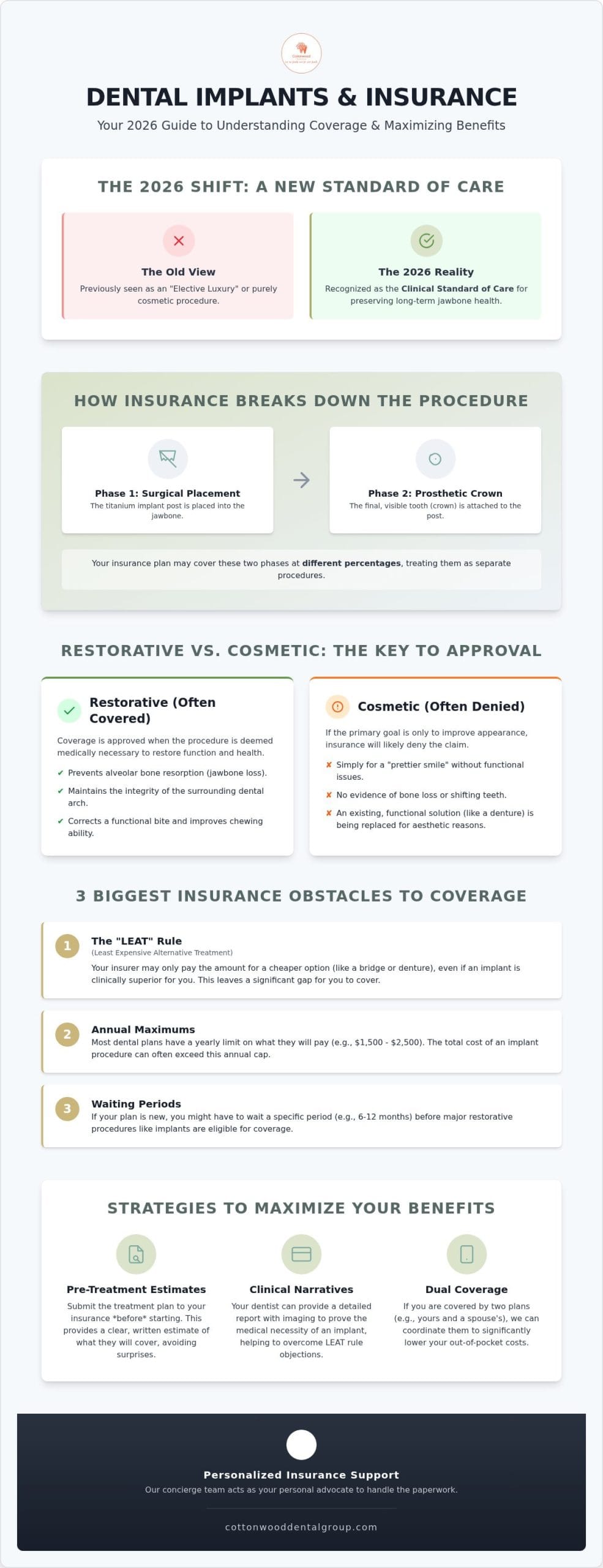
The landscape of dental benefits has shifted significantly. In 2026, the question of “does dental insurance cover implants” usually results in a more positive answer than in previous years. Most major PPO plans have finally moved away from viewing these procedures as elective luxuries. Instead, they recognize a dental implant as the clinical standard of care for tooth replacement. This change reflects a growing understanding that preserving jawbone health is essential for long-term wellness.
While coverage is more common, it’s rarely a simple “yes.” Insurance companies often split the procedure into two distinct phases: the surgical placement of the titanium post and the attachment of the final prosthetic crown. Your plan might cover one phase at a different percentage than the other. In rare cases involving significant trauma or reconstructive needs, your medical insurance might even contribute to the costs; however, this requires meticulous coordination between your dentist and medical providers.
Restorative vs. Cosmetic: How Insurers Decide
Insurance adjusters look for a clear distinction between wanting a prettier smile and needing a functional bite. If you are currently wondering, does dental insurance cover implants, it’s vital to understand that insurers look for a clear distinction between “restorative” and “cosmetic” care. If a procedure is deemed cosmetic, you’ll likely pay the full amount. However, if the tooth loss leads to bone degradation or shifts in your remaining teeth, it falls under restorative care. Medical necessity for dental implants in 2026 is defined as the clinical requirement to replace a missing tooth to prevent alveolar bone resorption and maintain the integrity of the surrounding dental arch. By focusing on bone loss prevention, we can often help patients secure the benefits they deserve.
The LEAT Rule: Least Expensive Alternative Treatment
Even when a plan technically covers implants, the “Least Expensive Alternative Treatment” (LEAT) rule can be a major hurdle. This clause allows insurers to limit their payment to the cost of a cheaper alternative, such as a bridge or a partial denture. If your plan has a LEAT clause, they might only pay for the cost of a partial denture, even if that solution isn’t ideal for your health. This often leaves a significant gap in your coverage. To combat this, we focus on clinical narratives. Dr. Parsons provides detailed evidence explaining why a bridge or denture isn’t a viable long-term solution for your specific health needs. Appealing these decisions with high-resolution imaging and professional testimony is often the key to unlocking higher reimbursement rates. For patients currently relying on removable plates, understanding how dental implants for dentures can provide a more stable and permanent foundation is an important part of this conversation.
Understanding Plan Categories and Implant Reimbursement
Insurance reimbursement is rarely a straight line. When patients ask, “does dental insurance cover implants,” they often expect a simple percentage in response. However, the specific structure of your plan dictates your final out-of-pocket costs far more than the coverage rate itself. Understanding the nuances between PPO, HMO, and Indemnity plans is the first step toward financial clarity and a successful restorative journey.
One common misconception is that “50% coverage” means the insurance company pays half of your total invoice. In reality, insurers pay a percentage of their own “allowed amount.” This figure is often lower than the actual cost of high-end restorative work. Negotiated rates can help bridge this gap by capping what an in-network provider can charge. If you choose an out-of-network provider, you may be responsible for the balance bill. This is the difference between the office fee and the insurer’s allowed amount. It’s also vital to check your policy for a “Total Implant Exclusion” rider. This specific clause can override your standard benefits, stating the plan won’t pay for any part of the process regardless of medical necessity.
Before diving into the financial math, it’s helpful to review What You Should Know About Implants from the FDA to understand the clinical components involved. This medical context explains why certain materials and surgical steps are necessary, even if your insurance tries to classify them as optional. Knowing the clinical value of your treatment helps you advocate for the coverage you deserve. If you’re feeling overwhelmed by these details, our team can help you verify your specific benefits before your consultation.
PPO Plans: The Gold Standard for Implant Choice
PPO plans are widely considered the best option for restorative care. These plans offer the flexibility to choose a provider based on skill and technology rather than a restricted list. This is particularly important for patients visiting a concierge practice like ours in Highlands Ranch. Even if a practice is out-of-network, your PPO might still provide substantial benefits for major services. To find your specific coverage, look at your Summary of Benefits. It will list a percentage for major restorative work, which is where most implant-related procedures are categorized. This flexibility ensures you don’t have to compromise on the quality of your care.
HMO and DHMO Limitations
HMO and DHMO plans operate on a capitation model where you’re assigned to a specific clinic. This often creates a hurdle for accessing advanced implant technology. Because HMOs prioritize cost-containment, they may limit access to specialists or use lower-grade materials for the final crown. We often see patients transition from an HMO to a PPO during their employer’s open enrollment period. This move allows them to work with a trusted expert like Dr. Parsons and ensures they receive the high-end materials necessary for a long-lasting smile. While HMOs are cheaper monthly, the limitations on specialized care can make them difficult to use for complex surgeries.
The 3 Biggest Insurance Obstacles to Dental Implant Coverage
Identifying that your plan technically offers coverage is only the first step. When researching “does dental insurance cover implants,” many patients are surprised to find “hidden” clauses that can derail a claim. These obstacles aren’t always obvious in the marketing materials provided by your HR department. You have to look closely at the fine print to see how these rules might apply to your specific health history. Understanding these hurdles early allows us to build a more accurate financial roadmap for your care.
The first hurdle is the waiting period. Many insurers require you to be a member for 6 to 12 months before they will contribute toward “major” procedures. If you have an urgent need, this delay can be frustrating. However, the most significant barrier is often the Missing Tooth Clause. Knowing these obstacles helps you avoid the “calendar year trap.” If you’ve been asking, does dental insurance cover implants for a tooth I lost years ago, the answer depends heavily on that specific policy rider.
Navigating the Missing Tooth Clause
This clause is perhaps the most misunderstood aspect of dental benefits. Effectively, the Missing Tooth Clause acts as a pre-existing condition exclusion, allowing insurers to deny coverage for any tooth lost prior to the effective date of your policy. It is a common gap in coverage that many online guides overlook. There are exceptions, though. If your tooth was lost due to a documented injury or if you switched plans during an employer transition without a break in coverage, we can often appeal the denial. Understanding the Types of Dental Plans available is crucial because some indemnity plans are more lenient with these clauses than restrictive HMOs.
Annual Maximums and the ‘Calendar Year’ Trap
Most dental plans have an annual maximum benefit, typically ranging from $1,500 to $2,500. While this is helpful for routine care, it is often insufficient for a comprehensive dental implants Highlands Ranch procedure. Once you hit that ceiling, you’re responsible for every dollar until the next calendar year begins. One effective strategy is the “Split-Year” approach. By timing your surgical placement in late December and scheduling the final crown for January, you can utilize two years of benefits for a single tooth. This simple scheduling shift can effectively double your insurance contribution and significantly lower your out-of-pocket investment.
Maximizing Your Benefits and Lowering Out-of-Pocket Costs
Strategic planning is the most effective way to manage the costs of restorative care. While the primary question remains, does dental insurance cover implants, the more practical concern is often how to bridge the gap between your benefits and the total fee. Coordination of benefits is an excellent starting point. If both you and your spouse have dental plans, you may be able to apply both annual maximums to a single procedure. This requires careful paperwork and a deep understanding of which plan is primary; however, it can effectively double your coverage for major services. It’s a sophisticated tactic that our concierge team handles frequently to ensure no benefits are left on the table.
For the remaining balance, many of our patients utilize third-party financing such as CareCredit or LendingClub. These options provide a flexible way to manage the investment without depleting your savings account all at once. By spreading the cost over several months, high-quality restorative care becomes accessible within a standard household budget. These plans often offer interest-free periods, making the financial side of your health journey as comfortable as the clinical side. Patients who are transitioning away from traditional plates will find that exploring dental implants for dentures as a financing option is well worth discussing with our team, as the long-term value often outweighs the initial investment.
The Power of the Pre-Treatment Estimate
At Cottonwood Dental Group, we prioritize transparency above all else. This is why we insist on obtaining a formal Pre-Treatment Estimate, often called a “Pre-D,” before scheduling your surgery. This document is a written response from your insurance company that clarifies exactly how much they will contribute based on your current remaining annual maximum and your plan’s specific “major service” percentage. It allows you to see your precise dollar responsibility before the first appointment, removing the fear of surprise bills. Once the financial path is cleared, you can focus entirely on your recovery and the vital dental implant aftercare required to protect your new smile for years to come.
HSA vs. FSA: Tax-Free Implant Savings
Health Savings Accounts (HSA) and Flexible Spending Accounts (FSA) are powerful tools for restorative dentistry. Because dental implants are a qualifying medical expense, you can use these tax-advantaged funds to pay for any portion of the procedure not covered by insurance. We recommend strategic planning during your employer’s open enrollment period. By increasing your contributions in the months leading up to your procedure, you effectively give yourself a discount on the surgery by using pre-tax dollars. Combining these funds with your insurance reimbursements is the most sophisticated way to minimize your out-of-pocket costs while investing in your long-term health. If you need help calculating your expected gap, contact our Highlands Ranch office for a personalized consultation.
Personalized Insurance Support at Cottonwood Dental Group
When you ask, does dental insurance cover implants, you deserve more than a vague estimate from a corporate call center. At Cottonwood Dental Group, we operate as your dedicated advocate throughout the entire restorative process. Our concierge model means we handle the heavy lifting of insurance coordination so you can focus on your health. Led by Dr. Parsons, our team specializes in translating complex clinical needs into the specific language insurance adjusters require for approval. We serve patients across Highlands Ranch, Lone Tree, and Centennial with a commitment to transparency that begins long before your procedure starts.
Our approach is built on the belief that high-end care should be paired with high-end service. This means we don’t just wait for a claim to be denied; we proactively provide the evidence needed to justify the procedure. Dr. Parsons creates detailed clinical narratives for every case. These narratives explain the necessity of bone preservation and the long-term health benefits of a stable bite. By providing this level of detail up front, we significantly increase the likelihood that your insurer will recognize the procedure as a restorative necessity rather than a cosmetic choice. For patients who want to explore faster restoration options, a dental implant consultation Highlands Ranch can help you determine whether same-day implants are a viable path for your specific clinical situation.
Insurance Advocacy in Highlands Ranch
Choosing a local, independent practice offers a distinct advantage when fighting for your benefits. Unlike large dental chains that use standardized billing, we have deep experience with the specific plans offered by Douglas County employers. Whether you are covered by local school districts or prominent tech firms in the area, we likely already know the nuances of your policy. We understand which plans are prone to restrictive riders and how to navigate them effectively. If your insurer attempts to apply a “LEAT” rule to limit your coverage to the price of a denture, our team steps in. We submit high-definition imaging and professional testimony to prove why a dental implant is the only appropriate solution for your specific clinical situation.
Beyond Insurance: Flexible Payment Solutions
What should you do if your employer-sponsored plan offers zero coverage for restorative surgery? We believe that financial hurdles shouldn’t stand in the way of a functional, confident smile. If insurance isn’t an option, or if you’ve already reached your annual maximum, we can design a phased treatment plan. This methodical approach breaks the procedure into manageable stages. By spreading the treatment over several months, you can pay for each component as it occurs rather than facing a single large invoice. This strategy, combined with our transparent billing and the secondary financing options discussed earlier, ensures your care remains affordable. Our goal is to provide a path forward that is entirely free from financial anxiety. Schedule your consultation at Cottonwood Dental Group today to discover how we can coordinate your benefits and help you achieve the smile you deserve.
Secure Your Smile with Financial Confidence
Achieving a permanent, beautiful smile shouldn’t be a source of financial stress. We’ve explored how the 2026 insurance landscape is more supportive than ever, yet it still requires a strategic approach to timing, plan selection, and policy fine print. While the question of does dental insurance cover implants remains nuanced, you now have the tools to navigate annual maximums and leverage tax-advantaged accounts effectively. You’ve learned that the right clinical narrative and a “Split-Year” strategy can make a world of difference in your final investment.
At Cottonwood Dental Group, we believe that clinical excellence should be matched by administrative ease. By combining Dr. Parsons’ clinical expertise with our dedicated concierge patient care, we ensure that every claim is handled with precision. Our commitment to transparent, no-surprise billing means you can move forward with your restorative journey without the fear of hidden costs. You don’t have to navigate these insurance complexities alone; our team is here to act as your steady guide.
Request an Insurance Benefits Check & Implant Consultation
We look forward to helping you reclaim your oral health with clarity and confidence. Your new smile is closer than you think, and we’re ready to help you secure it.
To maintain your new smile and ensure long-term oral health, routine exams and cleanings are essential; you can learn more about Blue Ridge Family Dentistry and their approach to comprehensive dental wellness.
Frequently Asked Questions
Is a dental implant considered a ‘major’ or ‘basic’ service for insurance?
Dental implants are almost universally classified as a “major” service rather than a “basic” or “preventive” one. This classification means they typically fall into the highest tier of your benefits package, often requiring a longer waiting period and higher patient co-insurance. While basic services like fillings might be covered at 80%, major services are frequently covered at 50% or less depending on your specific plan’s structure and fee schedule.
Can I get dental insurance that covers implants immediately without a waiting period?
Finding a plan that provides immediate coverage for restorative surgery is challenging but possible through specific employer-sponsored PPO plans. Most individual policies enforce a waiting period of 6 to 12 months for major services to prevent “claims-jumping.” If you are changing jobs, look for a policy with a “waiting period waiver” which credits your previous time with a prior insurer toward your new plan’s requirements and eliminates the delay.
Does medical insurance ever cover the cost of dental implants?
Medical insurance may provide coverage for dental implants if the tooth loss is the direct result of a traumatic injury, a congenital defect, or specific medical conditions like oral cancer. In these instances, the procedure is viewed as a reconstructive necessity rather than a dental restoration. Our team can help you coordinate with your medical provider to determine if your health insurance might contribute to the surgical phase of your treatment; you can also learn more about Inland Institute Oral & Maxillofacial Surgery to see how specialists document these complex reconstructive cases.
What happens if my insurance annual maximum is reached during the implant process?
If you reach your annual maximum benefit mid-procedure, you will be responsible for 100% of the remaining costs until your plan resets, which is typically on January 1st. This is why we carefully monitor your benefit usage throughout the year. If your treatment isn’t an emergency, we can often schedule the surgical and restorative phases across two different calendar years to maximize your available insurance funds and reduce your out-of-pocket costs.
How much of a dental implant does insurance typically pay for in 2026?
In 2026, most PPO plans that cover implants will pay approximately 50% of their “allowed amount” for the procedure. It’s important to remember that this percentage applies to the insurer’s fee schedule, not necessarily the office’s total fee. Consequently, the actual percentage of the total bill covered may be lower. Because does dental insurance cover implants in varying degrees, we recommend a pre-treatment estimate to see your exact dollar responsibility before you begin treatment.
What is a ‘Missing Tooth Clause’ and how does it affect my implant coverage?
A Missing Tooth Clause is a policy rider that prevents the insurer from paying to replace a tooth that was lost before your coverage began. It essentially treats tooth loss as a pre-existing condition. If your plan includes this clause, they won’t provide benefits for an implant to replace that specific tooth. However, exceptions exist for employer-sponsored plans that have “takeover” provisions from a previous insurer, which we can verify for you.
Does insurance cover bone grafting if it’s required for the implant?
Coverage for bone grafting depends entirely on how your insurer classifies the procedure. Some plans cover it as a necessary part of the implant process, while others categorize it as a separate “periodontal” service. If the graft is deemed medically necessary to support the implant fixture, it is typically covered at the same “major service” percentage as the surgery itself. We verify this specific detail during your initial concierge benefits check.
How do I find out if my Highlands Ranch employer plan covers implants?
The most reliable way to verify your Highlands Ranch employer plan is to have our concierge team perform a complimentary benefits check. Because does dental insurance cover implants is a question with thousands of potential answers based on local Douglas County group numbers, we contact your carrier directly. We can identify specific exclusions or riders that your HR department might not be aware of, ensuring you have a clear financial path forward.
