
October 9, 2026
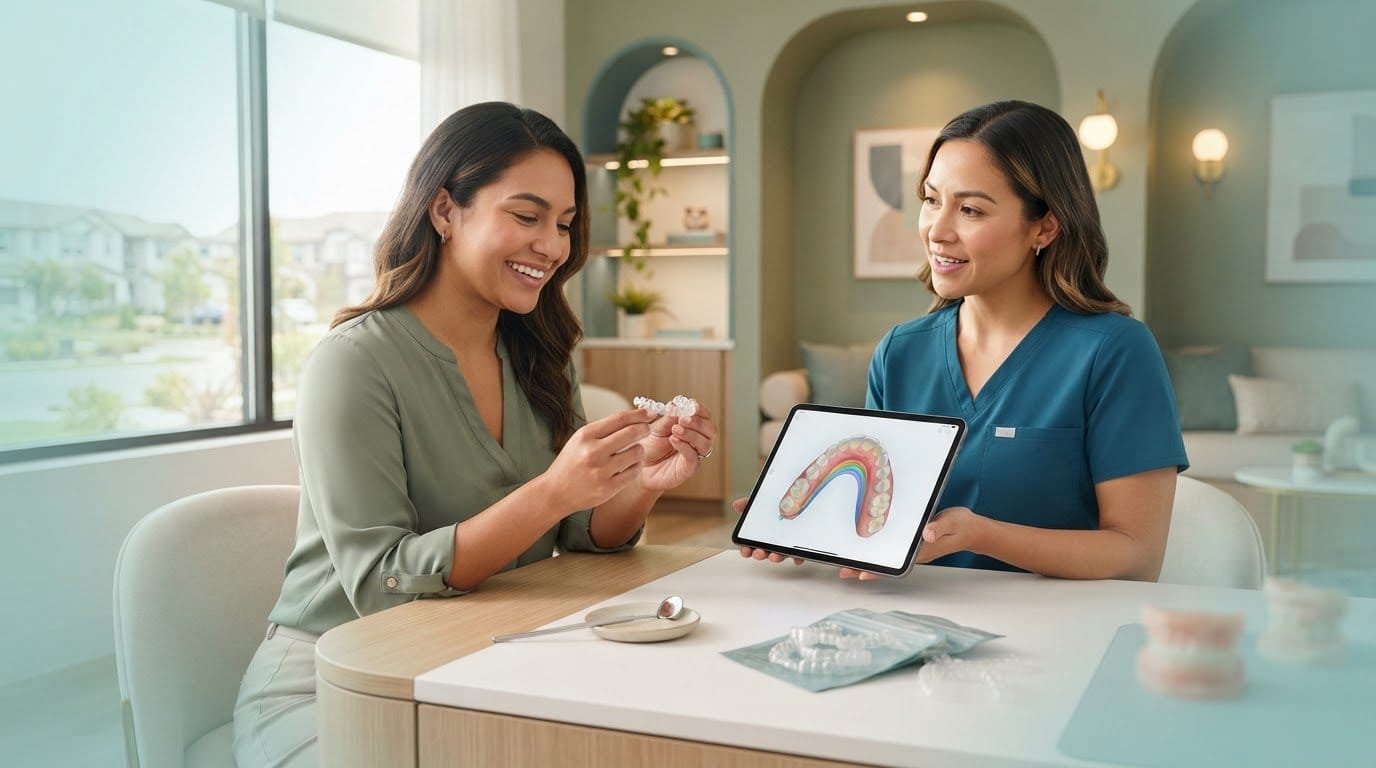
The most familiar aligner brand may not be the most important part of your treatment. A recognizable name can make research feel simpler, but it doesn’t show how a plan fits your teeth, bite, oral health, or smile goals. The benefits of custom clear aligners over brands come into focus when you look at the individualized planning and dentist guidance behind the trays, not just the name on the packaging.
It’s understandable to wonder how aligner options differ when marketing claims can be difficult to compare. The right approach depends on your needs, and clear aligners aren’t suited to every orthodontic concern. A clinical assessment can help determine whether clear tray orthodontics may fit your case and explain the considerations behind a proposed plan.
This article explains what to consider beyond brand recognition, including how a dentist-guided plan relates to your goals, what personalized care can and can’t do, and how to take a considered next step. At Cottonwood Dental Group, clear tray orthodontics is part of a personalized approach to dental care, giving you a place to discuss your smile and treatment considerations with a dental professional.
Key Takeaways
- Look beyond the brand name to understand how a clear aligner plan relates to your teeth, goals, and clinical assessment.
- The benefits of custom clear aligners over brands include a focus on individualized planning and professional guidance, rather than choosing by product label alone.
- Compare treatment options by considering assessment, personalization, professional support, convenience, and the responsibilities involved.
- A custom plan doesn’t automatically mean clear aligners are right for every smile. Candidacy depends on your needs and the alignment concern.
- A conversation about your smile goals and proposed care plan can help you explore clear tray orthodontics at Cottonwood Dental Group.
What Makes Custom Clear Aligners Different From Choosing by Brand?
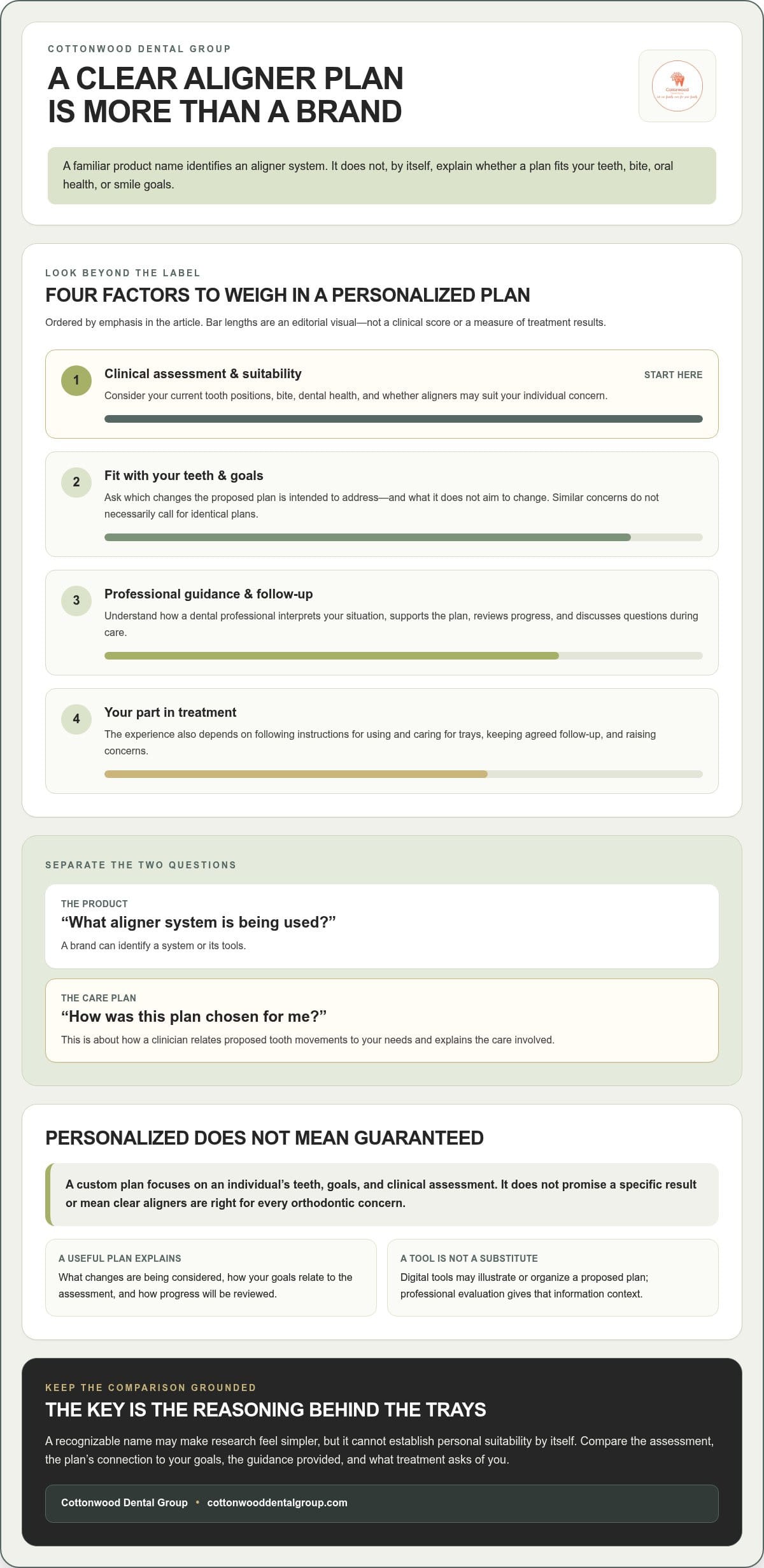
A clear aligner brand can identify the system or tools being used, but it doesn’t explain by itself why a particular approach may suit your smile. Custom treatment is shaped by the person wearing the aligners: their current tooth positions, intended changes, dental health, and the clinician’s assessment. The distinction is between the product and the decisions that guide its use.
Individualized aligner care is a treatment plan developed around a person’s teeth, goals, and clinical assessment, with professional guidance shaping how the plan is followed. That describes the care process, not a promise that treatment will be faster, more comfortable, or more effective than another option.
What does “custom” mean in clear aligner treatment?
“Custom” can describe trays made to fit a patient’s teeth, but a fitted appliance is only one part of treatment. A dental professional considers the current alignment and the changes a patient hopes to make, then evaluates whether aligners may be appropriate for that individual case. The Clear aligners overview provides general background on the appliance. Personal treatment decisions require attention to the individual, not just the device.
Why brand recognition does not answer every treatment question
A recognizable name may help identify a system, but it can’t establish personal suitability by itself. The overall experience also depends on your treatment goals, the clinical assessment behind the plan, how progress is supported, and what you need to do as treatment proceeds. No brand or method is universally best for every smile.
It helps to separate two questions: “What aligner system is being used?” and “How was this plan chosen for me?” The first concerns the product and its tools. The second concerns how a dental professional relates the proposed tooth movements to your needs and explains the care involved. Both questions matter, but the product label can’t answer the clinical one.
For example, two people may want to address crowded front teeth, yet have different starting alignment, bite, dental health, and broader goals. A shared concern doesn’t mean they should automatically receive identical plans. A careful conversation clarifies which changes are being considered and what the plan asks of each patient.
- Current alignment: Which aspects of your teeth are being considered?
- Your goals: Which changes matter most to you?
- Clinical judgment: How does the assessment inform whether aligners may be suitable?
- Care experience: What guidance and follow-up are part of the proposed approach?
These questions get closer to the benefits of custom clear aligners over brands: the focus shifts from recognition alone to the reasoning and support behind an individual plan. They also keep expectations grounded. Personalization helps make treatment relevant to a particular smile, but it doesn’t guarantee a specific result or mean aligners are right for every orthodontic concern.
How Personalized Planning Can Improve the Clear Aligner Experience
A thoughtful plan connects what you hope to change with what a dental professional observes, so you can understand the reasoning behind the proposed approach. A product label or digital preview may offer useful information, but neither replaces a conversation about your goals, oral health, and treatment considerations.
Personalization means matching a treatment plan to the patient’s needs and assessment, not guaranteeing a particular result. A plan can be designed with care and still depend on factors such as how your teeth respond and how consistently you follow the instructions provided.
How treatment goals shape an aligner plan
Start by describing what you notice and what you’d like to address. Is your main concern the appearance of your smile, the position of particular teeth, or another change? A clinician can consider those priorities alongside an assessment of your teeth and bite. This helps define which goals are relevant to the discussion, rather than assuming a familiar appliance category is the answer.
People can share a broad concern yet have different clinical needs. One person may be focused on a small visible area; another may have alignment concerns involving more of the smile. Those examples don’t determine which treatment is appropriate. They show why plans should be based on an individual assessment, not a general promise attached to a product.
Clear explanations matter, too. Ask what changes the proposed plan is intended to address, what it doesn’t aim to change, and how progress will be reviewed. Those details can help you decide whether the plan reflects your priorities and what questions you still have.
What professional guidance adds throughout care
Digital tools may help organize or illustrate a proposed plan, but they’re tools, not a substitute for professional evaluation. A dental professional interprets the information in light of your situation, discusses whether the approach is appropriate, and can review progress and questions during care. The tools can support planning; clinical judgment gives that information context.
Knowing your part matters. Clear aligner care involves following the instructions for using and caring for the trays, keeping up with agreed follow-up, and raising concerns when something doesn’t seem right. The precise responsibilities depend on the plan, so a clear explanation helps you understand what will be expected before you begin.
- Clarify the goal: Describe the changes that matter most to you.
- Understand the plan: Ask how the assessment connects to the proposed steps.
- Discuss expectations: Learn what progress review and patient responsibilities involve.
These are practical benefits of custom clear aligners over brands: the discussion centers on whether the plan makes sense for you, rather than assuming the name or software alone answers that question. At Cottonwood Dental Group, a personalized conversation about clear tray orthodontics can help you explore how your smile goals relate to treatment planning.
Custom Clear Aligners vs. Brand Names: What Should You Compare?
A useful comparison looks beyond the name on the aligner system and examines how care is planned and supported. A brand may describe its products, software, or system features, but those details don’t show on their own how a proposed plan relates to your smile. Use the questions below to compare the care experience, not just the marketing.
Which factors matter more than a logo?
Focus on whether the plan connects your goals with an individual clinical assessment. Ask how professional guidance fits into care and what you’ll be responsible for along the way. Materials and planning software can be relevant features, but they aren’t stand-alone proof that an approach is suitable for you.
| Factor | What to compare | Why it matters |
|---|---|---|
| Clinical assessment | What evaluation informs the proposed approach? | A product description alone can’t establish whether the approach fits your needs. |
| Plan personalization | How does the plan reflect your goals and the assessment? | It helps you see whether the proposed care is tailored to your situation rather than presented as one-size-fits-all. |
| Professional support | How can you discuss questions and have progress reviewed? | Understanding the support around treatment adds context beyond the aligner system itself. |
| Convenience | What does following the plan involve in daily life? | Convenience depends on the care process and your routine, not simply the brand’s message. |
| Patient responsibilities | What instructions, care, and follow-through are expected? | Knowing your role helps you understand what participation entails. |
Use the table as a guide for reviewing information, not as a scorecard that declares one brand or method the winner. The benefits of custom clear aligners over brands are easier to assess when you can connect the proposed plan to your goals and understand the professional guidance and patient responsibilities involved.
How to read brand claims with perspective
Separate specific, verifiable system details from broad promises. A statement about a named feature or tool describes that system; it doesn’t automatically show how the feature applies to your case. Claims of superiority or guaranteed outcomes deserve careful scrutiny, and brand-specific figures should be checked against reliable, current sources before they’re repeated.
Comfort, convenience, and treatment progress can matter to patients, but promotional language isn’t a substitute for individual discussion. A feature may be relevant without proving that a particular plan is right for you. Likewise, a general claim about results doesn’t predict an individual outcome. Suitability and progress vary by person, so avoid treating any brand as universally best.
Before deciding, try summarizing the proposed plan in your own words: what it aims to address, how the assessment informs it, how support is provided, and what you’ll need to do. If those points are clear, you’re comparing the care behind the system as well as the system itself.
Are Custom Clear Aligners Right for Every Smile?
No. A plan tailored to an individual doesn’t mean clear aligners are automatically suitable for every patient or every alignment concern. Whether clear tray orthodontics may fit depends on a professional assessment, the person’s goals, and the nature of the changes being considered. An evaluation helps put potential benefits and limitations in context before someone chooses an approach.
Potential benefits and practical trade-offs
For some patients, clear aligners may offer a discreet way to address alignment concerns. Because they’re removable, they can be taken out for meals and routine cleaning, which may make certain daily activities more convenient. These are potential advantages, not a guarantee of comfort or a sign that aligners are right for a particular smile.
Removability also comes with responsibility. Patients need to follow the wear guidance provided by their dental professional and care for the trays as instructed. Taking them out more often than directed, or not following the plan, may affect the intended course of care. Ask what daily use involves and how the instructions fit your routine. Convenience works best when you understand the commitment, too.
Consider practical questions alongside appearance:
- Are you comfortable wearing a removable appliance according to professional guidance?
- Can you keep track of the trays and care for them as instructed?
- Do you understand what the proposed plan aims to address and what it doesn’t promise?
When a professional evaluation matters
A dental professional can assess whether clear tray orthodontics fits your needs and discuss how your goals relate to the alignment concern. A general interest in straighter teeth isn’t enough to determine candidacy. Different or more complex concerns may call for a broader clinical discussion about appropriate treatment options. That doesn’t mean aligners are unsuitable in every complex case; it means the decision should be based on an individual evaluation, not a broad brand claim.
Bring your questions to that conversation. You might ask what the assessment considers, which changes the proposed plan is intended to address, what responsibilities you’ll have, and how questions or progress concerns can be discussed. Clear answers help you weigh the convenience of removable trays against the care and consistency they require, without assuming a specific timeline or outcome.
The benefits of custom clear aligners over brands are best understood as a focus on individual needs and clinical judgment, not as proof that aligners suit everyone or outperform every other option. A personalized approach can clarify whether this form of orthodontic care aligns with your goals while keeping expectations realistic.
If you’re considering this option, explore clear tray orthodontics at Cottonwood Dental Group and take a considered next step toward understanding your smile’s needs.
Explore Personalized Clear Tray Orthodontics in Highlands Ranch
Choosing clear tray orthodontics is a personal decision, and a useful next step is a conversation centered on your smile rather than a brand name. Cottonwood Dental Group offers clear tray orthodontics within a personalized, concierge-care approach. For people in Highlands Ranch, Lone Tree, Centennial, Castle Pines, and Parker, that means having a place to discuss goals, understand an assessment, and review a care plan with a dental professional.
What to expect when discussing clear tray orthodontics
The discussion can begin with what you’d like to change and which questions matter most to you. A clinical assessment helps put those goals in context and inform whether clear tray orthodontics may suit your needs. The practice’s personalized approach helps you understand the considerations behind a proposed plan, without assuming that one appliance or treatment path is right for every smile.
You don’t need to arrive with every answer. It can help to describe what you notice, explain what you hope to address, and mention any concerns about wearing and caring for removable trays. From there, you can discuss the assessment and proposed plan, including what it aims to address and what it doesn’t promise. That conversation can make the decision clearer and more grounded in your priorities.
Questions that help you make a confident decision
Bring questions that connect the care plan to everyday life. Ask how the proposed approach relates to your smile goals, what responsibilities you’d have, what limitations to keep in mind, and how professional follow-up fits into care. Clear answers can help you weigh the possible convenience of aligners against the consistency and participation they require.
- Which of my smile goals does the proposed plan address?
- What should I understand about the assessment and its role in planning?
- What responsibilities would I have while following the plan?
- How can I discuss questions or concerns as care progresses?
If you’re also considering changes beyond alignment, learning about cosmetic smile treatment options can help you think about your goals in a broader context. Keep the conversation focused on what you want to understand, rather than feeling pressured to decide based on a brand’s name or a broad claim. The benefits of custom clear aligners over brands are most relevant when the plan and guidance are considered in relation to your own needs.
A personalized discussion won’t guarantee a particular result, but it can help you understand the assessment, proposed approach, and whether it fits your priorities. To take a considered next step, schedule a clear tray orthodontics discussion with Cottonwood Dental Group.
Take a Thoughtful Next Step for Your Smile
As you consider treatment, try shifting the question from “Which brand should I choose?” to “What do I want a care plan to address, and what would help me feel informed as I proceed?” That perspective keeps your priorities at the center. The benefits of custom clear aligners over brands are most meaningful when the discussion helps you understand how care could relate to your goals, without treating any option as a guaranteed fit.
You don’t need to have every decision made before starting a conversation. Bring the questions you still have, and give yourself room to understand the assessment and consider the proposed next step. Cottonwood Dental Group offers clear tray orthodontics as part of its personalized, concierge dental care in Highlands Ranch. Explore personalized clear tray orthodontics with Cottonwood Dental Group and take a confident, considered step toward learning what may suit your smile.
Frequently Asked Questions
Is a custom clear aligner plan better than choosing a brand?
Not automatically. A custom plan may be more relevant when it reflects your individual needs, but the brand and care surrounding it matter too. To compare thoughtfully, ask whether the proposed approach addresses the change you care about and whether you understand why it was recommended. The benefits of custom clear aligners over brands depend on how well the plan fits your situation, not on the word “custom” alone.
Can custom clear aligners treat more problems than branded aligners?
There isn’t a universal answer, because suitability depends on the concern being addressed and the capabilities of the specific system and approach. “Custom” describes how treatment is planned for an individual; it doesn’t establish that aligners can manage a wider range of concerns. Ask which aspects of your alignment the proposed plan is intended to address, and whether any goals may call for additional clinical consideration.
How do I compare clear aligner brands objectively?
Use the same questions for each system: what features are documented, what evidence supports specific claims, and how does a dental professional relate those features to your needs? Separate a verifiable product detail, such as a named tool, from promotional language about being faster or superior. Note what you still don’t understand and ask for a plain-language explanation before weighing one option against another.
Are clear aligners always more comfortable than braces?
No. Comfort varies from person to person, and aligners can still feel unfamiliar or create pressure as treatment progresses. Their removable design and lack of brackets and wires don’t guarantee a completely comfortable experience. If a tray feels unexpectedly uncomfortable or you have concerns about how it fits, contact your dental professional for guidance rather than changing your plan on your own.
Do custom clear aligners work faster than branded aligners?
Not based on the word “custom” alone. The time involved depends on the proposed treatment and individual factors, so a general brand claim isn’t a personal estimate. If you’re given a duration expectation, ask what it’s based on, which goals it covers, and what could affect it. This helps distinguish a general promotional statement from an estimate discussed in relation to your own plan.
What happens if clear aligners are not the right fit for my smile?
A dental professional can explain why clear tray orthodontics may not match your needs and discuss the clinical considerations relevant to your goals. You can ask what the assessment revealed, which concerns affect suitability, and what options or next steps merit discussion. Cottonwood Dental Group offers personalized dental care in Highlands Ranch for patients in Lone Tree, Centennial, Castle Pines, and Parker. Start with a conversation about your goals and the treatment considerations that matter to you.
